



Verbraucherforschungsforum 2025
On December 10, 2025, the Consumer Research Forum 2025 took place at the University of Mannheim. This forum is held annually by research institutions in Baden-Württemberg in cooperation with the Ministry of Food, Rural Affairs and Consumer Protection. This year's topic was “Finfluencers, Roboadvisor and More in Focus of Consumer Research: Current Insights into Opportunities and Risks.” Experts from academia, politics, and practice gathered in Mannheim to share recent research findings and practical insights.
Prof. Dr. Thomas Fetzer (President of the University of Mannheim) welcomed the participants at the start of the event. In his speech, he emphasized the relevance of financial education for social cohesion and asked how digitalization and artificial intelligence can contribute to better financial education without ignoring the associated risks. Financial education should not only be considered from a theoretical perspective but also disseminated beyond the academic community.
In the first contribution from academia, Dr. Leah Zimmerer (University of Mannheim & ZEW) addressed the portrayal of women in financial advertising. Gender stereotypes remain prevalent: women are mostly depicted in decorative roles with a focus on their physical appearance, whereas men are commonly portrayed as independent and in professional contexts. Such gender-stereotypical representations may negatively affect women’s investment behavior. However, the trend appears to be declining, and women are now more frequently presented in professional roles.
Felix Kuske (University of Mannheim) reviewed the current state of research on the use of digital technologies in financial education. The literature is dominated by studies examining videos and e-learning tools. Research gaps persist particularly regarding innovative technologies, transformative approaches, and learning formats that involve content creation. Moreover, most studies focus on young adults as the primary target group.
In the third presentation, Dr. habil. Matthias Horn (University of Bamberg) spoke about the opportunities, risks, and need for action regarding chatbots as investment advisors. Sophisticated, independent chatbots can serve as a second opinion when searching for information prior to medium- to long-term one-time investments and can help to verify recommendations. However, they are unsuitable for spontaneous summaries and for interpreting highly complex information (e.g., on ESG-related risks). In addition, more consumer guidance is needed on safe and data protection-compliant use.
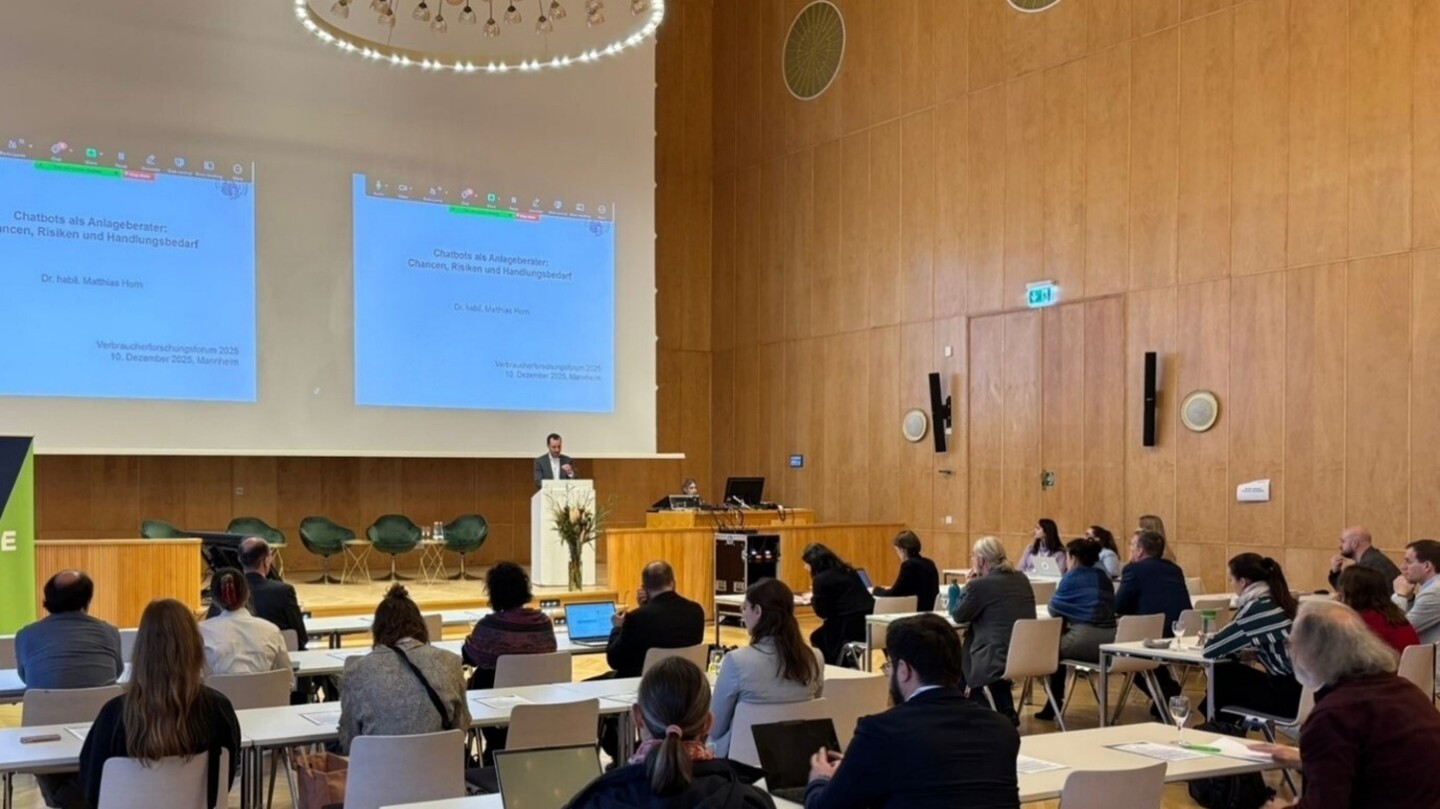
In his digital speech, Minister Peter Hauk MdL (Ministry of Food, Rural Affairs, and Consumer Protection Baden-Wuerttemberg) stressed the relevance of evidence-based and practice-oriented consumer protection. Consumers should above all be protected from fraudulent and misleading offers and schemes in digital environments and be empowered to act independently and in an informed manner.
Niels Nauhauser (Verbraucherzentrale Baden-Wuerrttemberg) critically examined the role of finfluencers in consumer education: it is often difficult for consumers to distinguish between fraud, advertising, and information, and there is often a lack of qualifications, especially when it comes to “hot” tips. Platforms are insufficiently regulated, laws are rarely enforced, and algorithms amplify fear- and greed-driven content. Stricter regulation and consistent disclosure requirements were therefore called for. Finfluencers should therefore rather be the subject of consumer education so that consumers can better assess their interests and evaluate them critically.
Luisa Heizmann and Marie Harzenetter (ZEBRA/BW-Zentrale Beratungsstelle für Weltanschauungsfragen) addressed the growing demand for coaching services driven by social changes, the desire for easily accessible support, social media visibility, mistrust towards institutions, and barriers to psychotherapy. While coaching can provide valuable support, it also carries risks when it comes to dubious offers, which is why critical scrutiny by consumers is important.
Jörg Janotte (Federal Financial Supervisory Authority – BaFin) explained how BaFin monitors current financial innovations to ensure market stability and consumer protection. The focus lies on AI, distributed ledger technology (DLT), Open Finance, neobrokers, robo-advice, and finfluencers, among other things. While new technologies can improve processes, they also entail risks, such as new security threats. Finfluencers can impart knowledge, yet consumers must remain vigilant— especially when it comes to unrealistic promises of returns or non-transparent motives. Financial education and regulatory oversight are therefore of central importance.
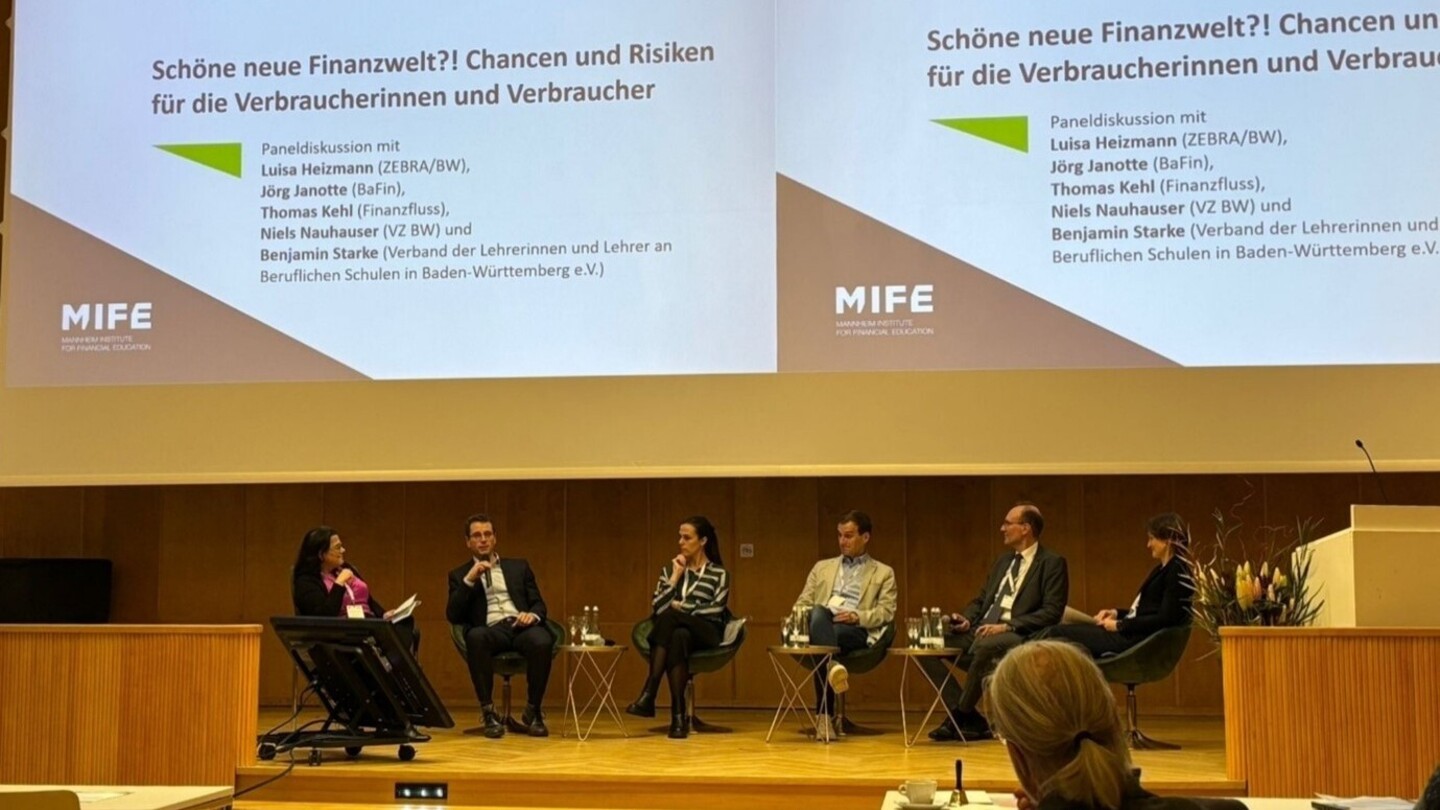
Under the moderation of MIFE Directors Prof. Dr. Carmela Aprea and Prof. Dr. Tabea Bucher-Koenen, Luisa Heizmann (ZEBRA/BW), Jörg Janotte (BaFin), Niels Nauhauser (VZ BW), and Benjamin Starke (Verband der Lehrerinnen und Lehrer an Beruflichen Schulen in Baden-Württemberg e. V.) discussed the topic: “Brave New Financial World?! Opportunities and Risks for Consumers.” The panel addressed current developments, highlighting not only the risks discussed in the presentations but also the opportunities arising from digitalization and financial innovation. These include simplified access to financial knowledge and products, as well as reduced transaction costs—such as opening brokerage accounts or comparing and selecting investment options. Given the associated risks, policymakers, researchers, and educational stakeholders are called upon to protect consumers, provide guidance, and promote critical and risk-aware thinking. The demand for such is particularly strong among young people, as demonstrated by the popularity of the school subject “Private Wealth Management” at business high schools in Baden-Württemberg.