
Academic Speed Dating – Spring Semester 2026: Experiments and Causal Research with AI
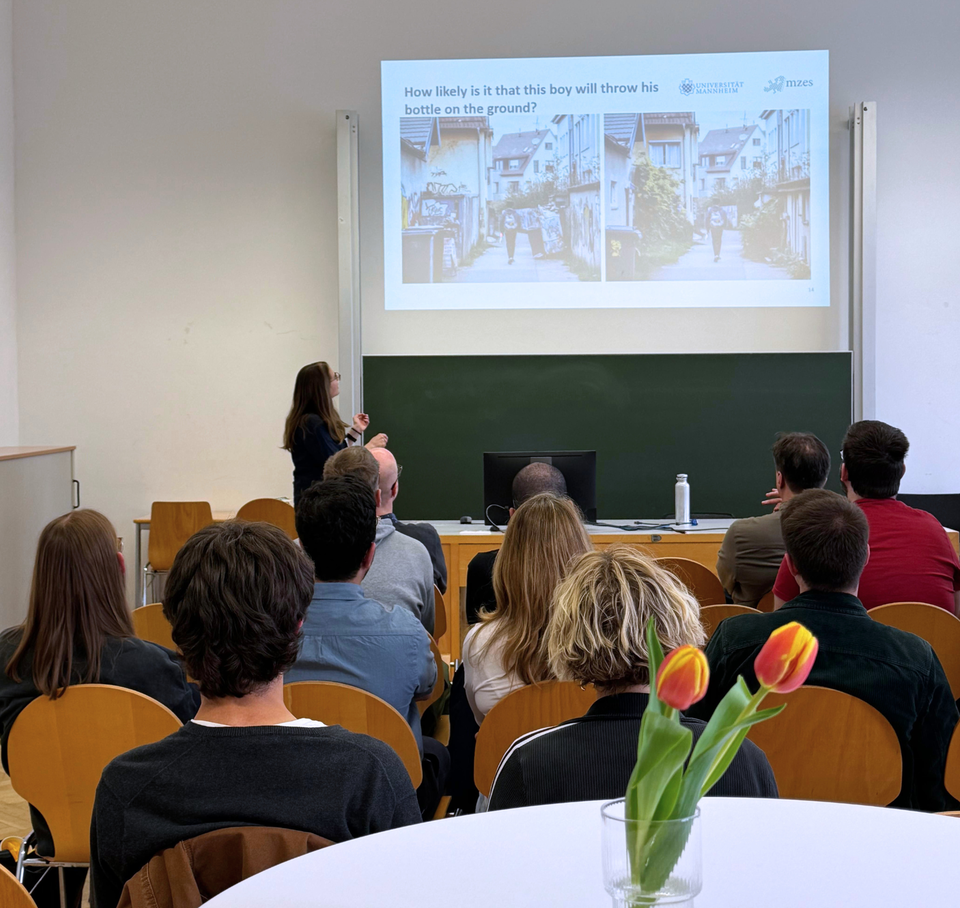
The Academic Speed Dating in the Spring Semester 2026 brought together around 35 participants from different faculties at the University of Mannheim for an inspiring afternoon of academic exchange. Organized by the Mannheim Center for Data Science, the event has become an established platform for connecting researchers across disciplines and career stages.
Under the theme “Experiments and Causal Research with AI”, the event focused on current developments at the intersection of artificial intelligence, experimental methods, and causal inference. The event was moderated by Prof. Florian Keusch, who guided participants through the program.
The afternoon began with a keynote by Prof. Marc Ratkovic, Chair of Political Science with a focus on Social Data Science at the University of Mannheim.
Prof. Marc Ratkovic delivered his keynote titled “Text as a Random Variable: Linguistic Theory, Fisher Geometry, and More Powerful Tests”:
Large language models have shifted text analysis from word counts to embeddings: text is mapped to vectors, and inference is performed in vector space. But operations that are natural for vectors—such as addition, scalar multiplication, and inner products—are not natural for language. We ask what operations are natural and use this to motivate taking text seriously as a mathematical object. We ground our answer in the structuralist linguistics of Louis Hjelmslev, whose theory defines language entirely through relations of substitution and combination, using a linguistic structure that corresponds to how and what LLMs learn. We formalize Hjelmslev's commutation test, which holds that two strings are similar to the extent they are substitutable across a common set of frames, as a reproducing kernel under the Fisher-Rao metric. Standard optimality results follow: the resulting test is the most powerful available from the LLM as a measurement instrument. We distinguish representation efficiency from estimator efficiency: even a doubly robust estimator on topic model scores cannot recover information that the topic model has discarded.
On a benchmark experiment (Egami et al., 2022), the cross-fit t-statistic rises from 23 in the best embedding specification to 35 in our framework. The gain comes entirely from combining insights from structural linguistics and established strategies from causal inference.
A second keynote was given by Dr. Nicole Schwitter, postdoctoral researcher at the Mannheim Centre for European Social Research (MZES).
Dr. Nicole Schwitter presented on “Using Generative AI for Experimental Stimuli in Social Research”:
Factorial survey experiments are a powerful tool for studying causal effects of multidimensional stimuli. Recent advances in generative AI provide new opportunities to create customizable text and image stimuli in a flexible and scalable way. This talk demonstrates how AI-generated vignettes, both visual and textual, can be used to systematically vary multiple attributes across large sets of experimental materials. This approach allows for a more efficient exploration of complex treatment spaces while potentially enhancing realism and engagement in survey experiments without sacrificing experimental control. At the same time, the use of AI in experimental design raises methodological challenges, including issues of validity and bias. The presentation discusses how these challenges can be addressed while keeping researchers closely involved in the design and evaluation process. Overall, the talk positions generative AI not just as a tool for efficiency, but as a methodological innovation that expands the design space of causal research.
The program was complemented by short presentations from researchers:
Dr. Ruben Bach, Research Fellow at the Mannheim Centre for European Social Research (MZES), examined whether abstaining from Instagram can improve body image. Against the backdrop of growing evidence linking social media use to body dissatisfaction, eating disorders, and mental health outcomes, as well as ongoing policy debates on regulation, his research addresses the challenge of identifying causal effects in this domain.
Johanna Hölzl, PhD candidate at the Graduate School of Economics and Social Sciences, presented research on the use of large language models to classify manifest and latent constructs in online Reddit posts, with an application to gender differences in discussions about (un)paid work in relationship conflicts.
Prof. Davud Rostam-Afschar, Professor of Accounting at the University of Mannheim and Academic Director of the German Business Panel, presented new approaches to experiments and causal inference with AI. His talk focused on so-called batched bandit experiments, which enable adaptive treatment assignment while efficiently balancing exploration and exploitation. He also discussed methodological challenges related to statistical inference in such settings.
The short presentations provided numerous starting points for further discussion, which continued in smaller groups and during the informal get-together. The format once again fostered interdisciplinary exchange as well as the development of new ideas and collaborations.
The Mannheim Center for Data Science would like to thank all speakers and participants for their contributions and is already looking forward to the next edition of Academic Speed Dating in the Fall Semester 2026.