
Academic Speed Dating im Frühjahrssemester 2026: Experiments and Causal Research with AI
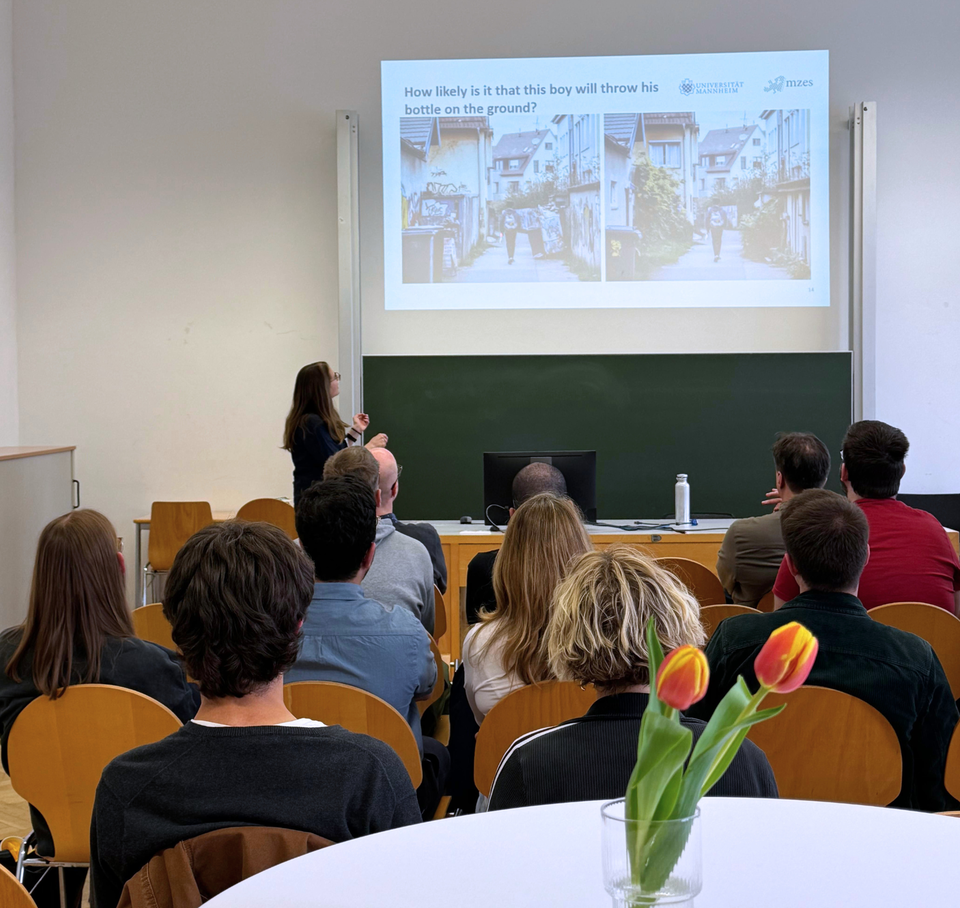
Das Academic Speed Dating im Frühjahrssemester 2026 brachte rund 35 Teilnehmende aus verschiedenen Fakultäten der Universität Mannheim zu einem inspirierenden Nachmittag des wissenschaftlichen Austauschs zusammen. Die vom Mannheim Center for Data Science organisierte Veranstaltung hat sich als feste Plattform für die Vernetzung von Forschenden unterschiedlicher Disziplinen und Karrierestufen etabliert.
Unter dem Leitthema „Experiments and Causal Research with AI“ standen aktuelle Entwicklungen an der Schnittstelle von Künstlicher Intelligenz, experimentellen Methoden und kausaler Inferenz im Fokus. Die Moderation übernahm Prof. Florian Keusch, der durch das Programm führte.
Den Auftakt bildete der erste Keynote-Vortrag von Prof. Dr. Marc Ratkovic, Inhaber des Lehrstuhls für Politikwissenschaft mit Schwerpunkt Social Data Science an der Universität Mannheim.
Prof. Dr. Marc Ratkovic hielt seine Keynote mit dem Titel „Text as a Random Variable: Linguistic Theory, Fisher Geometry, and More Powerful Tests“:
Large language models have shifted text analysis from word counts to embeddings: text is mapped to vectors, and inference is performed in vector space. But operations that are natural for vectors; like addition, scalar multiplication, inner products; are not natural for language. We ask what operations are natural, and use this to motivate taking text seriously as a mathematical object. We ground our answer in the structuralist linguistics of Louis Hjelmslev, whose theory defines language entirely through relations of substitution and combination, using a linguistic structure that corresponds to how and what LLMs learn. We formalize Hjelmslev's commutation test, which holds that two strings are similar to the extent they are substitutable across a common set of frames, as a reproducing kernel under the Fisher-Rao metric. Standard optimality results follow: the resulting test is the most powerful available from the LLM as a measurement instrument. We distinguish representation efficiency from estimator efficiency: even a doubly-robust estimator on topic model scores cannot recover information the topic model discarded.
On a benchmark experiment (Egami et al., 2022), the cross-fit t-statistic rises from 23 in the best embedding specification to 35 in our framework. The gain comes entirely from combining insights from structural linguistics and established strategies from causal inference.
Ein zweiter Keynote-Vortrag wurde von Dr. Nicole Schwitter, Postdoktorandin am Mannheim Centre for European Social Research (MZES) gehalten.
Dr. Nicole Schwitter sprach zum Thema „Using Generative AI for Experimental Stimuli in Social Research“:
Factorial survey experiments are a powerful tool for studying causal effects of multidimensional stimuli. Recent advances in generative AI provide new opportunities to create customisable text and image stimuli in a flexible and scalable way. This talk demonstrates how AI-generated vignettes, both visual and textual, can be used to systematically vary multiple attributes across large sets of experimental materials. This approach allows more efficient exploration of complex treatment spaces while potentially also enhancing realism and engagement in survey experiments, without sacrificing experimental control. At the same time, the use of AI in experimental design raises methodological challenges, including issues of validity and bias. The presentation discusses how these challenges can be addressed while keeping researchers closely involved in the design and evaluation process. Overall, the talk positions generative AI not just as a tool for efficiency, but as a methodological innovation that expands the design space of causal research.
Ergänzt wurde das Programm durch Kurzvorträge von Wissenschaftlerinnen und Wissenschaftlern:
Dr. Ruben Bach, Research Fellow am Mannheim Centre for European Social Research (MZES), untersuchte die Frage, ob ein Verzicht auf Instagram das Körperbild verbessern kann. Vor dem Hintergrund wachsender Evidenz, die Social-Media-Nutzung mit Körperunzufriedenheit, Essstörungen und mentaler Gesundheit in Verbindung bringt, sowie aktueller politischer Debatten über Regulierungsmaßnahmen, widmet sich seine Forschung der kausalen Identifikation dieser Effekte.
Johanna Hölzl, Doktorandin an der Graduate School of Economics and Social Sciences, präsentierte Forschung zum Einsatz von LLMs zur Klassifikation manifester und latenter Konstrukte in Online-Reddit-Beiträgen, mit einer Anwendung auf Geschlechterunterschiede in Diskussionen über (un)bezahlte Arbeit in Partnerschaften.
Prof. Dr. Davud Rostam-Afschar, Professor für Rechnungswesen an der Universität Mannheim und akademischer Leiter des German Business Panels, stellte neue Ansätze für Experimente und kausale Inferenz mit KI vor. Im Fokus standen sogenannte Batched Bandit Experimente, die adaptive Treatment-Zuweisungen ermöglichen und dabei Exploration und Exploitation effizient verbinden. Zudem diskutierte er methodische Herausforderungen bei der Inferenz.
Die Kurzvorträge boten zahlreiche Anknüpfungspunkte für weiterführende Diskussionen, die in kleineren Gruppen und beim anschließenden Get-together in offener Atmosphäre vertieft wurden. Das Format förderte erneut den interdisziplinären Austausch sowie die Entwicklung neuer Ideen und Kooperationen.
Das Mannheim Center for Data Science dankt allen Vortragenden und Teilnehmenden herzlich und freut sich auf die nächste Ausgabe des Academic Speed Dating im Herbstsemester 2026.