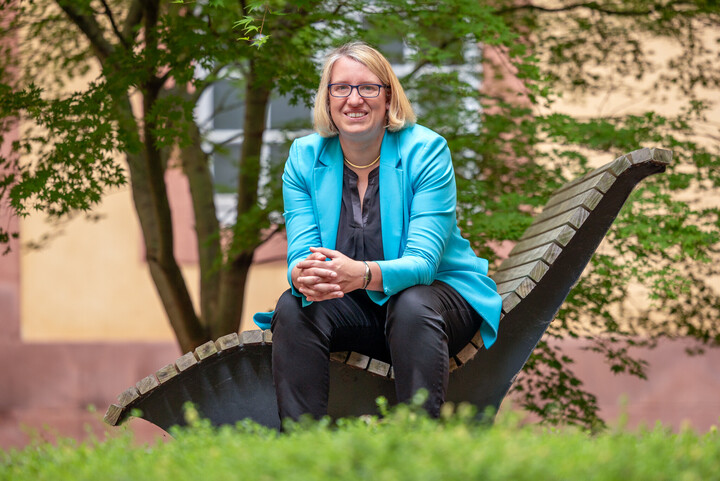

Catching up with … Manuel Ludorff
Max Liebermann, Käthe Kollwitz, Pablo Picasso: many people have admired their paintings in museums. Mannheim Business School alumnus Manuel Ludorff, by contrast, has actually owned some of them. That is hardly surprising — he is an art dealer. Yet even for him, certain works are so compelling that he will drop everything to pursue them.

On 11 November at precisely 11:11 a.m. — the moment when carnival season officially begins across Germany’s Rhineland and many locals head out to celebrate — Manuel Ludorff is doing something rather unexpected: sitting down for an interview with his alma mater. A native of Düsseldorf who still lives there today, he laughs at the seeming contradiction. “We’re carnival-minded at heart,” he says, “but compared with Cologne things are a bit less intense here. We had an event there over the weekend, and the artworks were collected yesterday. I’m actually relieved it’s only the eleventh now — once carnival starts in Cologne, getting anywhere becomes nearly impossible.”
Now 48, Ludorff is an art dealer and gallerist in the second generation. Fifteen years ago, he took over Galerie Ludorff from his father. “As a gallerist, I work with living artists and present their work in our gallery,” he says. “In the art trade more broadly, we also deal in works by deceased artists — Käthe Kollwitz, for instance. We can’t represent them, of course, so we search for their works around the world, acquire them, exhibit them, or place them on loan with museums.”
Setting the course
Manuel Ludorff was born shortly after his father began acquiring his first works in 1975 and gradually building a collection. As a child, he played among paintings and sculptures in the gallery and grew up surrounded by them. After graduating from secondary school, he faced the familiar question of what to study. “I was free to choose my subjects — and what I would do afterwards,” he recalls. “There was never any pressure from my parents to take over the art business.”
He began studying business administration, reasoning that it offered a strong foundation for many possible careers. He completed his early coursework in Marburg, spending semester breaks on internships with a photographer, an auction house, two banks, and a start-up incubator. He then spent a year at Bocconi University in Milan before deciding to continue his studies in Mannheim. “I wanted the credits I earned in Italy to transfer, and Mannheim made that possible,” he explains.
Student years in Mannheim
That decision brought him to the Schloss for the final stage of his degree. Mannheim had another advantage: Marburg was close by. “My future wife was still studying there,” Ludorff says. Many of his friends also moved to Mannheim. Although chance played a role, he emphasizes how much he enjoyed his time at the university. “What fascinated me most was the program’s real-world focus. We once had a lecture with a member of Porsche’s executive board, and a seminar project with Roche.”
He lived near the Rhine, a setting he remembers fondly. Alongside his studies, he worked in his father’s gallery, set up its website, assisted at art fairs, and helped with acquisitions and exhibition planning. “Even so, I still had time to focus on my studies — and on student life. The Schneckenhof parties, especially after exams, were practically mandatory,” he says with a laugh. After graduating, he joined ABSOLVENTUM. “It felt natural to stay connected to my alma mater.”

Back to Düsseldorf
Diploma in hand, Ludorff moved to London to gain international experience, working for the renowned Marlborough Gallery. Six years later, he joined his parents’ gallery. “It wasn’t an easy decision. We loved London. But in the long run it was clear that to move forward there, we would have had to start our own business. Back home, not only our family but also an extraordinary entrepreneurial platform was waiting for us.” Stepping into his father’s footsteps, he admits, was not without challenges. “Things can go wrong — personally and with long-standing clients. But we were fortunate. My father gave me a great deal of freedom, and we were able to develop and gradually introduce significant changes.”
As he speaks, it becomes clear how right that decision proved to be. “I’ve been fascinated by art from an early age,” Ludorff says. “There’s a kind of magic to it. Of course, it involves a lot of work, but I’ve always loved working in the gallery.” He adds another conviction: “Art brings people together. It makes them light up. Creating opportunities for encounters and exchange is important to me.” Over the years, the gallery has hosted visits from ABSOLVENTUM regional groups, a kindergarten class connected to one of his staff members, subscribers to the Frankfurter Allgemeine Zeitung, museum friends’ groups, Rotary groups, and even an international CEO network.
Life as an art dealer
Each day, the gallery receives countless emails offering artworks for sale or appraisal. On one occasion, just two days after being alerted to a painting, Ludorff boarded a plane to Houston without a purchase agreement or contract. “My wife thought I was crazy. But I knew that if I didn’t fly out to meet the owners and discuss my ideas with them in person, I would never secure the work. And so I managed to acquire for the gallery a unique and truly outstanding painting by Otto Mueller — one that attracted enormous attention when it came onto the market. It was an absolutely singular opportunity: to hold a work of such quality and distinction in my own hands — and to be involved in its sale. Works of this caliber are typically held in museum collections for decades.” The trip proved worthwhile. Ludorff successfully brokered the painting and established a trusting relationship with a family whose members, over generations, have built up a remarkable collection now dispersed among them.
By the end of the interview, one thing is clear: art remains the defining theme of Ludorff’s life — discovering works, conducting research, curating exhibitions, attending fairs, and maintaining a gallery as a space with a distinct identity. Yet one word recurs throughout: “we.” Nothing would be possible, he emphasizes, without his wife, his parents, and his team.
Text: Luisa Gebhardt / April 2026