

Increased Military Spending May Not Lead to Economic Return
The planned massive increase in Germany’s military spending may contribute significantly less to economic development than is often claimed. This is the finding of a new study by economists Professor Tom Krebs, Ph.D., and Dr. Patrick Kaczmarczyk from the University of Mannheim.
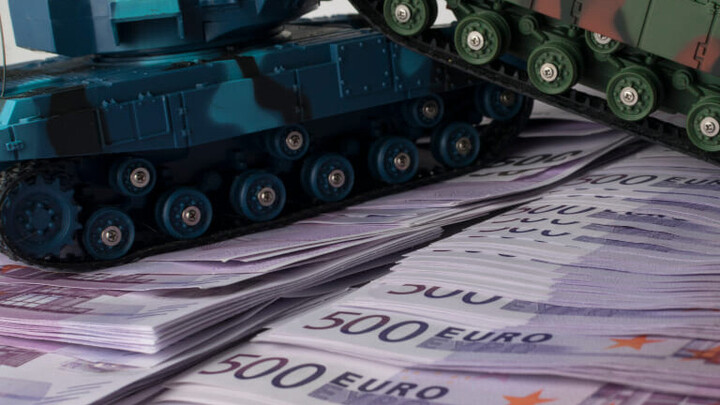
The German government plans to significantly increase its defense spending in the upcoming years. Up to five percent of the GDP will be invested in expanding the military. Alongside security policy objectives, politicians also have economic expectations. They hope for a modernization boost for the industry and new impetus for economic growth.
However, the study by economists Professor Tom Krebs, Ph.D., and Dr. Patrick Kaczmarczyk from the Chair of Macroeconomics and Economic Policy at the University of Mannheim shows a different result: The fiscal multiplier, which measures how much additional government spending increases the GDP, is a maximum of 0.5 for military spending in Germany. This means: In the best-case scenario, every euro spent leads to 50 cents of additional economic activity. By contrast, public investment in education, infrastructure, and childcare achieves significantly higher multipliers, generating two to three times as much additional value added, according to the study. Professor Tom Krebs, Ph.D., concludes that “from an economic perspective, the planned militarization of the German economy is a risky gamble with low overall economic returns.”
The authors attribute the weak impact to structural characteristics of the German defense industry, among other factors: It is already operating at a high capacity and characterized by little competition. New government orders would therefore be more likely to lead to price increases than to an expansion of production. In addition, large listed defense companies have already benefited massively from political announcements and special budgets in recent years.
Defense spending pushes reforms aside
Krebs and Kaczmarczyk also warn of long-term crowding out effects: The expansion of production in the defense sector ties up both financial and human resources that could be lacking for other tasks relevant to society—such as investments in climate protection, education, or the maintenance of public infrastructure. Despite reforms to the debt brake, the government's financial leeway remains limited. According to the authors of the study, it is therefore hardly realistic to expand all key policy areas at the same time. “How long a free pass for military spending will be politically tenable while other areas of the federal budget are being cut is an open question,” warns Dr. Patrick Kaczmarczyk.
Text: Fabio Olsen / April 2026