
In Vinolin Veritas
Turning a hobby into a career is a cliché for many — but for Mannheim alumnus Simon Blank and his brother David, it has become reality. With their start-up Vinolin, the two business informatics graduates combine what they learned at university with their passion for wine.

At the Heilbronn Weindorf in September 2025, visitors could choose from 20 wine stands and around 400 different labels. Red, rosé, or white; dry, off-dry, or sweet — or perhaps alcohol-free? Even seasoned wine lovers can quickly lose their bearings at a festival like this.
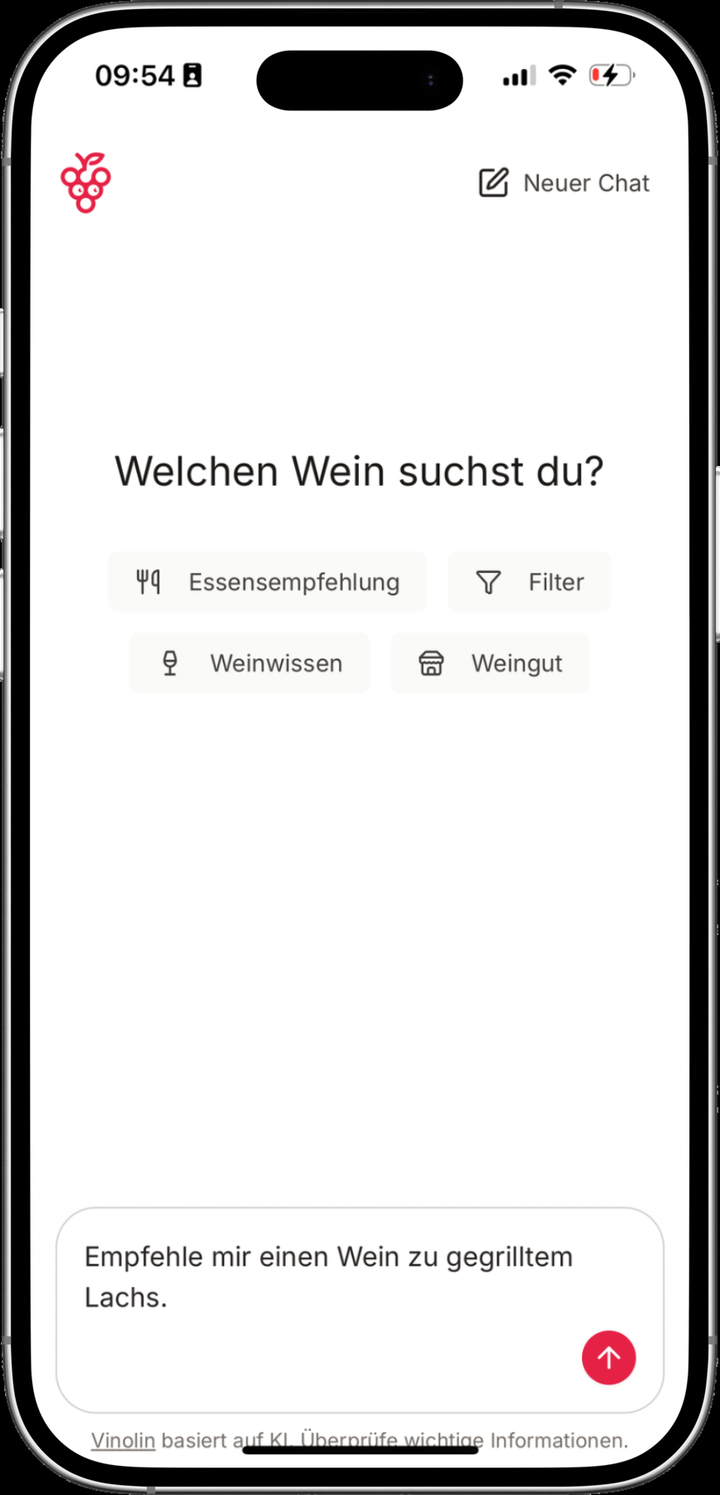
But help is at hand: QR codes at each stand lead visitors straight to Vinolin — an AI-powered advisor that always has the right (wine) answer for every taste. The digital sommelier was programmed by brothers Simon and David Blank, who founded their start-up of the same name in October 2024.
“We never expected Vinolin to be used at a major public event so soon,” says 26-year-old Simon Blank. After all, the siblings originally developed the AI sommelier primarily for wineries to integrate into their websites. There, potential customers can get detailed advice: Vinolin suggests which wines from a winery’s portfolio best match their personal taste or pair well with a planned meal.
From VinUM to Vinolin
Blank says he has always been interested in wine — and, he adds with a laugh, “of course I’ve always enjoyed drinking it, too.” Back home in Bad Mergentheim, in the German state of Baden-Württemberg, he says vineyards and wine festivals are everywhere. But another key influence on the business idea was the student organization VinUM, which he joined while studying business informatics at the University of Mannheim. “At various meetings and events, I quickly realized that the wine industry isn’t doing well. Sales are declining, and many regional producers are struggling to survive,” recalls Blank. “That’s when I developed the desire to get young people excited again about this centuries-old beverage.”
The idea took shape in early 2024, when Blank and his brother David — who at the time was completing his master’s degree in business informatics at TU Darmstadt — were browsing a winery’s online shop. “You could book video calls to get advice from staff, but only days later. We immediately knew there had to be an easier way — and since both of us had worked with language models in our studies, we quickly came up with the idea for Vinolin,” Blank says.
A survey of around 50 wineries across Germany showed that they were really onto something. “More than 90 percent of respondents said they would use Vinolin. It really is a problem: online sales are becoming more and more important, but most customers don’t have the expertise they need,” Blank explains. Development began — and by the end of 2024, Vinolin went live on a first set of winery websites.
“For wineries themselves, it’s very little work,” Blank adds. “We’ve built a computer program — a so-called web crawler — that pulls product data from their shops and feeds it into the AI. Vinolin then appears as a chatbot in the corner of the screen.” Just one year after founding the start-up, more than 20 online shops are already using the AI advisor, and the brothers now employ two staff members and one student assistant from the University of Mannheim.
Advice for supermarket shoppers
Blank looks back fondly on his time in Mannheim’s Baroque palace. “With so many classes online, I could study when and where I needed to — that made a huge difference,” he says. “Otherwise, founding a start-up alongside my studies would have been very difficult.” Many of the skills he learned during his degree also proved invaluable in developing Vinolin, Blank adds.
The team has ambitious plans for the coming year: launching the AI advisor as a smartphone app, adding new features such as maps of wine-growing regions, and promoting winery events. “One of our biggest projects is the grocery retail sector. We want to bring Vinolin into wine departments as a standalone kiosk. After all, supermarkets are another popular place to buy wine where customers often lack access to expert advice,” Blank explains. And the Heilbronn Weindorf? “The chances are good that we’ll be back again in 2026.”
Text: Jessica Scholich / April 2026