
In Profile: Margret Keuper
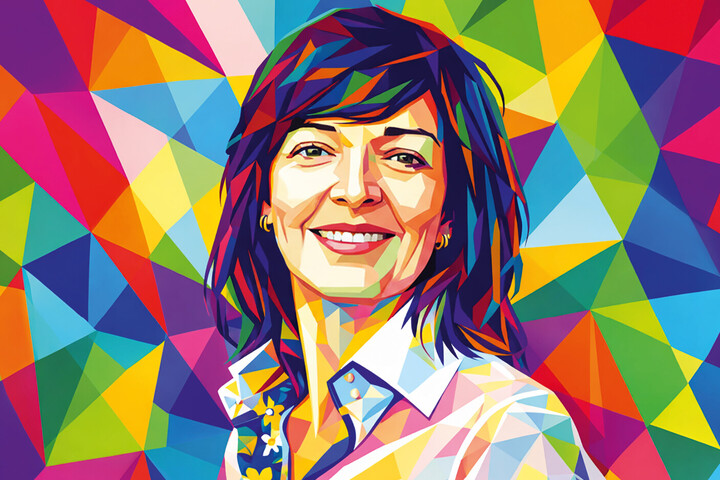
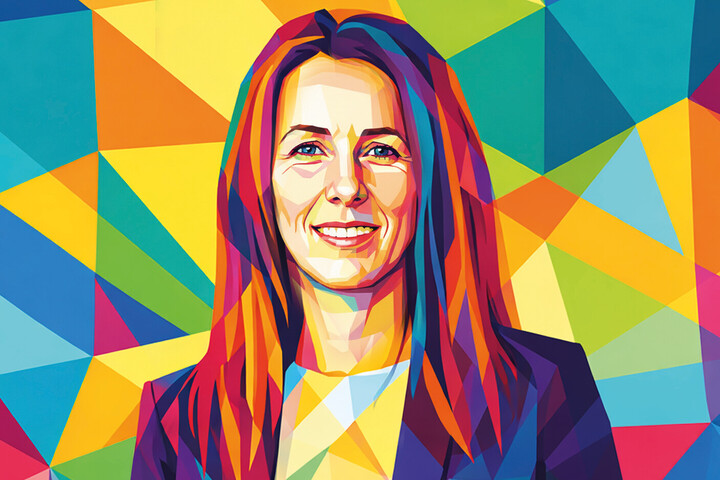
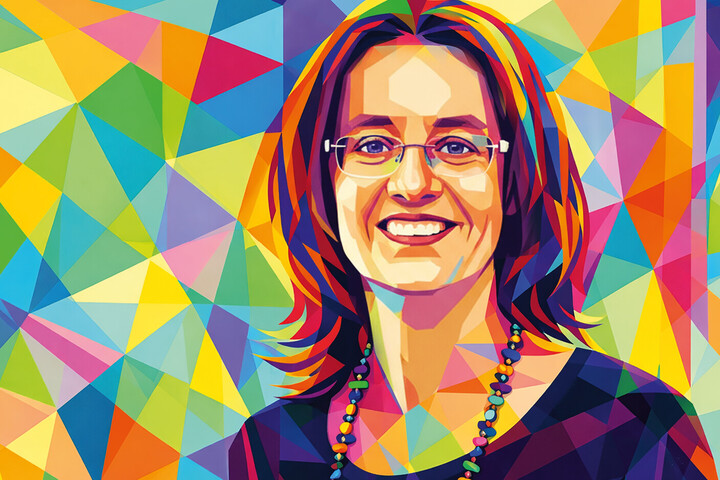
The high school classroom gave way to the lecture hall: When Margret Keuper began training to become a schoolteacher in the early 2000s, she had no idea her career would one day bring her to the Schloss. Today she holds the chair in machine learning — and has long been the only female professor of Computer Science at the University of Mannheim.
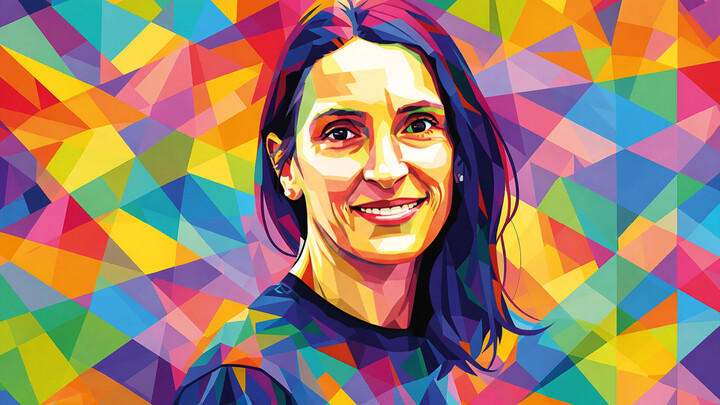
“My career path isn’t exactly typical,” says Margret Keuper, a professor of machine learning at the University of Mannheim, with a smile as she sits in her office in B6 on a Friday morning. As a teenager, she had a very different dream: becoming a teacher. “I always liked the idea of explaining things to people,” she recalls — which is why she enrolled at the University of Freiburg in a teacher-training program in German and French.
But it didn’t stop there: driven by curiosity and a desire to learn more, she eventually found herself sitting in on a computer science lecture. “Like many girls, I assumed that the subject wasn’t for me and would be boring,” she says. “But I enjoyed it immediately and decided to pursue it.” Not instead of her teaching degree, but alongside it. The programs complemented each other well, she explains: computer science required intense work during the semester, while her German and French coursework concentrated in the semester breaks.
Her subsequent career reflects both ambition and discipline. After completing both her teaching qualification and a degree in computer science, she knew she wanted to stay in computer science — and in research. “Looking back, I may have been a bit naïve not to consider other options,” she says, “but I felt very comfortable at the research chair.” Another factor also mattered in her decision to pursue a doctorate: nearly half of the doctoral researchers were women. Compared with the small number of female computer science students, she recalls, that was unusual — and reassuring. “It was nice to know I wouldn’t be the only woman.”
An immediate fit
Keuper remained in Freiburg, earning her doctorate in 2012 in computer vision, a subfield of artificial intelligence, and continuing as a postdoctoral researcher. She describes herself as fortunate to work simultaneously in two research groups, gaining different perspectives on scientific questions. Beginning in 2013, she also worked at the Max Planck Institute for Informatics in Saarbrücken — the city where she grew up.
Four years later she came to Mannheim for the first time, as a junior professor in image processing. “Honestly, one of the main reasons I took the job was that everybody in the department was so nice,” she says. “You don’t often walk into a place and immediately think, ‘I’d love to work with these people.’” Proximity to home also mattered: by then she was already the mother of two.
“At the time, I wasn’t able to stay in Mannheim,” she says. But two years later, after a professorship at the University of Siegen, the right opportunity came along. “To expand teaching in data science, the University of Mannheim created a new professorship in machine learning, with a focus on computer vision—exactly my area of research. I was really glad it worked out because I value the atmosphere among my colleagues and how motivated the students are.”
Keuper has now held the chair in machine learning at the Institute of Computer Science and Business Informatics for more than two years — making her the only woman among fourteen computer science professors. More female colleagues would be welcome, she says — also for the students’ sake. “Computer science programs still enroll far more men than women, and the lack of female professors may influence prospective students’ choices.” At the same time, she observes that the women who do choose business informatics are often particularly motivated and ambitious.
A focus on fundamentals
Keuper’s research sits at the intersection of computer vision and machine learning. “In practical terms, we develop machine learning-based methods that are used primarily for analyzing image data.” Her emphasis on developing and refining methods rather than specific applications stems from a simple reason: personal interest.
“It makes me happy to understand things from the ground up,” she says. “I want to know how to design a method so it works across many different situations.” Analyzing dashcam footage is one example. “If I train a model only on daytime video, it won’t perform well at dusk. That’s why we study how performance changes under different conditions and how the models need to be adjusted.”
Support at home
When Keuper talks about her research, her passion for computer science is unmistakable. And it’s a passion she gets to share at home, too. “My husband is also a computer science professor,” she says. “That helps a lot — we understand each other and support each other when work can’t wait.”
The couple live in Homburg, about an hour’s drive from Mannheim, with their five children. “It’s fairly rural,” she says with a laugh. “We need the space.” The Saarland town means a somewhat longer commute, but she’s happy to accept it: Homburg lies conveniently between her workplace in Mannheim and her hometown of Saarbrücken.
Text: Jessica Scholich / April 2026