

Center for Advanced Studies
With the Center for Advanced Studies (CAS), the University of Mannheim is further advancing its interdisciplinary collaborative research. The Center focuses on new research alliances, innovative topics, and networking among fellows from different schools.
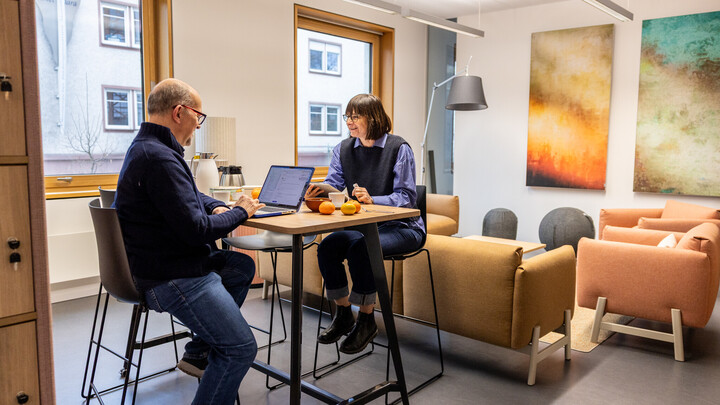
“With the Center for Advanced Studies, we are creating a space where excellent research can gain new momentum beyond school and disciplinary boundaries,” says President Professor Thomas Fetzer. Professor Jutta Mata, Vice President for Research and Career Paths in Academia, adds: “The CAS is a central component of our new research strategy. We are deliberately creating spaces where research collaborations and networks can emerge that form the basis for future Collaborative Research Centers and Clusters of Excellence.”
Up to ten fellowships are awarded each year, divided into two cohorts: one in the spring semester and one in the fall semester. Each fellowship includes funding for a substitute professor and is financed through external funding. Significant support for the financing of the fellowships at the University of Mannheim has been provided by Dr. Hans-Peter Wild, who, as a benefactor of the Stiftung Universität Mannheim, initiated the ‘Best Heads Program.
The first cohort will begin
In the first call for applications last year, six fellows from three schools were selected. They will work together on the project Knowledge acquisition, representation, and application in human minds and machines. The project focuses on how knowledge acquisition and processing function in human and artificial cognitive systems under real-world conditions.
Carola Trips has been collaborating with Charles Yang of the University of Pennsylvania since 2018; together, they initiated the interdisciplinary group. Yang joins the cohort as an international guest. In the 2025 fall semester, the group organized a joint lecture series titled “Unwrapping the Mind: Knowledge, Cognition, and AI,” which attracted strong interest across the university. The fellows of the first cohort have been meeting weekly this semester in dedicated CAS spaces. Beginning in March, guest lectures will be held on Wednesday evenings. All members of the university are warmly invited to attend.
For upcoming events, visit the website of CAS.
Text: Editorial Team / April 2026
Introducing the First Fellowship Cohort
General Psychology

“We’re all interested in closely related questions, just from different angles — that’s what makes this program so valuable. We finally have the time to sit down together, exchange perspectives, and work toward something bigger. I think of myself as a tinkerer, someone who enjoys designing experiments to prove ideas — which isn’t always easy when you’re studying cognition. That’s where my experimental curiosity comes in.”
English Linguistics/
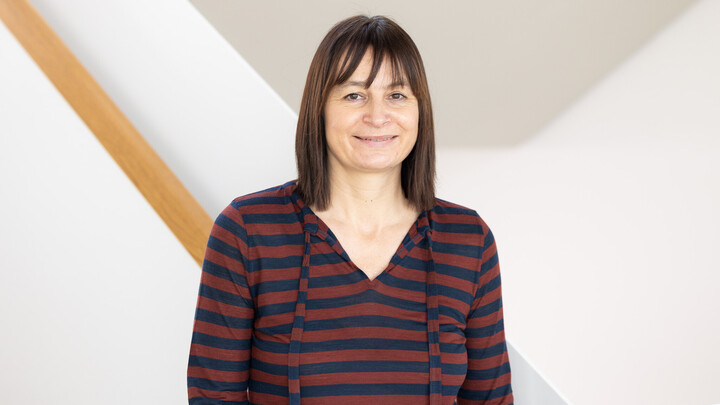
“My background is in historical linguistics, meaning I study language change using historical data. But I’ve always been especially interested in the question of why language changes. That naturally leads to questions of language acquisition and, more broadly, learnability. Taking an interdisciplinary perspective makes a huge difference. As a group, we really have something to say to one another — I find our collaboration very inspiring.”
Philosophy

“As a philosopher, I’m naturally interested in the topics we’re discussing here — AI, language acquisition, memory and forgetting. But as a philosopher of science, I’m also interested in the methodologies of different disciplines. I’m curious to see how we can bring together our research interests and approaches.”
Cognitive Psychology/
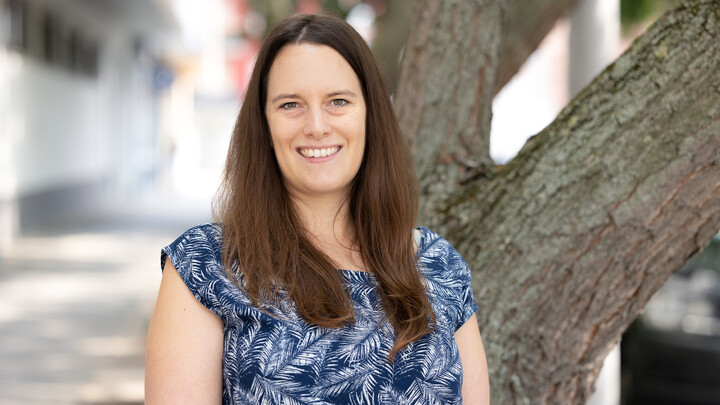
“I’ve already learned a great deal through this collaboration. It has pushed me to refine my concepts and define my terms more precisely, because people here ask really good questions. We’re all working on cognition, so we share a common scientific language and understand each other well. At the same time, I bring the perspective of cognitive aging into the discussion, which is important to me.”
Computer Science/

“As a computational linguist, I currently work a lot on machine learning — how AI acquires knowledge and language. In this group, I’m exposed to entirely new perspectives on these questions. How do my findings relate to those from other disciplines? Sometimes the overlaps are quite striking — for example, when we think about how a computer ages compared to the human brain.”
Psycholinguistics/

“My research has long focused on language acquisition: how linguistic representations are learned and how information is stored. These are fundamental questions that we’re now addressing together in this project. And they really require an interdisciplinary approach. As a psycholinguist, I find many points of connection here.”
Linguistics and Computer Science, University of Pennsylvania

“I am interested in how humans learn and how we learn differently from AI systems. Through the connection with the historical linguistics group, I met a group of cognitive science faculty members at Mannheim and have been delighted to be part of their research initiative supported by CAS.”