
EduSpace: A Flexible Learning Environment
From plenary discussion to small-group collaboration in just minutes: the new EduSpace turns flexibility in teaching into a tangible reality. After 18 months of planning and renovation, the space will officially open at the end of April 2026.
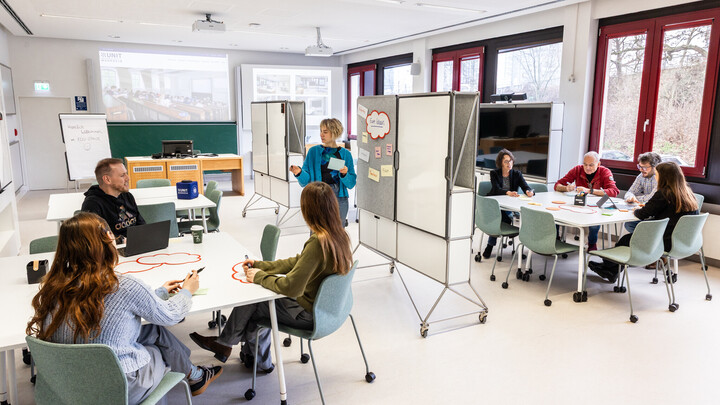
With a few quick adjustments, university staff glide mobile partition walls almost silently across the floor, reposition screens, and reconfigure seating areas. What moments earlier hosted a whole-group discussion can be transformed in under five minutes into five separate zones for workshop-style group work.
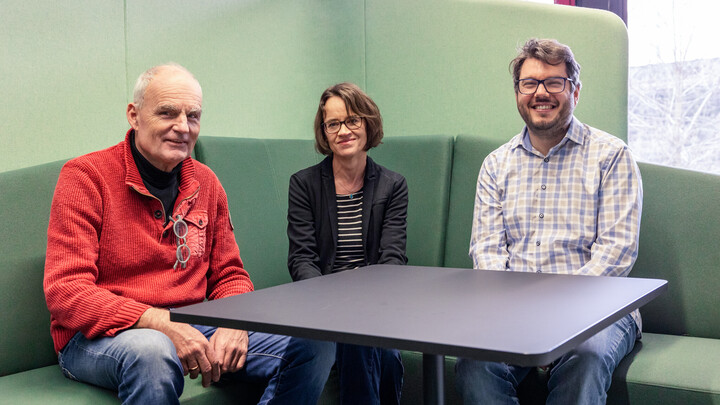
“EduSpace represents a shift in perspective: the room is designed to adapt to people — not the other way around,” says Niko Baldus, Deputy Head of the Teaching and Learning Center (ZLL). Working with a cross-institutional team — including Jessica Kaiser from the University Library, Ralf-Peter Winkens and Andreas Helbig from University IT, and Annika Frank from the ZLL — he spent 18 months developing and implementing the spatial concept.
Interaction and movement
Faculty and students were involved in shaping the space from the outset. Through workshops and surveys, they gathered ideas and identified needs. Their priorities were clear: greater flexibility, more interaction, a broader range of teaching methods, and hybrid formats that seamlessly connect in-person and online participation. “The biggest challenge was finding a location where these ideas could actually be realized,” Baldus recalls.
The vision ultimately took shape in the former Lecture Hall 004 in Building L 9, 1–2. Participants can now move freely rather than remain seated in fixed rows. Mobile whiteboards and pinboards can be positioned wherever they are needed, while screens equipped with videobar systems enable collaborative work with remote participants. “Whether someone is physically present or joining online, the room’s design and technology are intended to provide a largely equivalent experience for everyone.”
A comfortable environment for productive work
The space is also defined by its distinctive atmosphere: calming colors, high-quality materials, and generous personal space. At the entrance, a presentation wall featuring living moss creates a pleasant indoor climate, adding a touch of nature to an otherwise artificial environment. EduSpace accommodates up to 40 participants — and the wide range of teaching scenarios that can unfold there, from group workshops and gallery walks to hybrid sessions with international partners.
After a two-hour workshop, participants make their way out while, inside, the next team is already rearranging the movable walls into a new configuration. Although the official opening will take place on April 28, 2026, as part of the university’s Day of Teaching, the space is already in active use.
For Baldus, EduSpace represents more than just a flexible classroom. “In the future, students will increasingly acquire knowledge independently, supported by digital tools,” he says. “That makes it all the more important for in-person teaching to focus on what emerges through collaboration: new insights, critical debate, and shared problem-solving.” Spaces like this offer a glimpse of what teaching may look like in the years ahead. And in Building A 5, 6, EduSpace 2 is already awaiting its own opening.
Text: Patrick Kullmann / April 2026