
In Profile: Stefanie Egidy
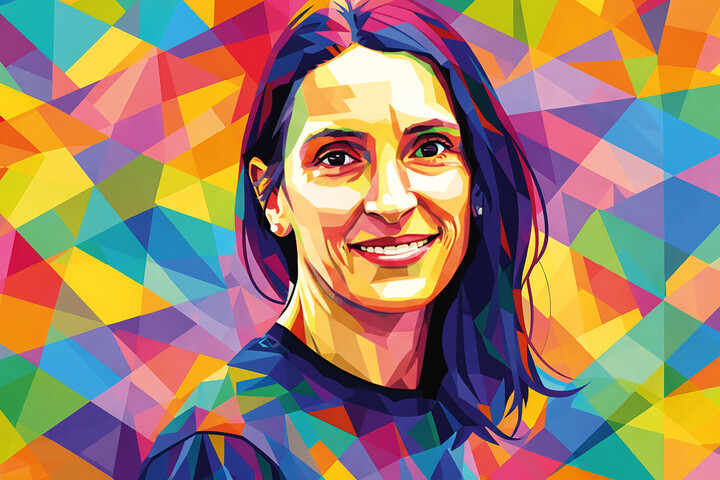
Her first encounter with the law came through television courtroom shows. As a teenager, Mannheim law professor Stefanie Egidy was fascinated by the back-and-forth of legal argument — and by the idea that conflicts could be resolved fairly based on objective criteria. Today, the former top graduate studies how institutions and democratic systems continue to function in times of crisis and amid sweeping transformations such as digitalization.

The original interview date had to be postponed. Stefanie Egidy had been invited, on short notice, to the German Bundestag to advise lawmakers on a pending piece of legislation. We meet the following day instead. Wearing a knee-length black dress, a houndstooth jacket, and a dark blue scarf, she arrives straight from teaching a master’s-level class on data protection and public information law.
Can democracy hold up?
Egidy was appointed to the Chair of Public Law, Economic Analysis, and Public Commercial Law in 2023. Her research centers on how democratic systems respond to challenges. “In public law, the focus is on whether institutions and democratic systems remain functional — specifically regarding the separation of powers, for example an independent judiciary,” she explains.
In her doctoral dissertation, she used the global financial crisis as a case study to examine how democratic systems respond and remain functional during crises. How can transparency and democratic oversight be preserved when governments must act quickly and pass legislation under pressure? In her habilitation, she approached the issue from another angle: how can democratic systems respond when legal proceedings are used strategically to establish precedents for future cases? Her analysis also included so-called SLAPP suits — lawsuits intended to intimidate journalists and others through legal pressure. Just the day before our meeting, she had presented her expertise on the topic in the Bundestag.
A fascination with law
Now in her early forties, Egidy is a sought-after scholar. She has turned down several offers from other universities in order to remain in Mannheim. As a child — the eldest of six siblings — she dreamed of becoming a dancer, preferably a ballerina. But she soon realized it wasn’t going to become a career. Her interest in law began with courtroom shows on television. “In the early days, shows like Streit um 3 or Wie würden Sie entscheiden? were still based on real-life cases,” she recalls. “I was about twelve or thirteen, and I found the legal back-and-forth fascinating — looking at a dispute from multiple perspectives. And the idea that law offers a tool for resolving conflicts without simply saying: I like this better, I like that less. That fascinated me even then.”
From that point on, her career path reads almost like a textbook example of how to become a professor: advanced coursework in economics and law in high school with an inspiring teacher, legal studies at the University of Würzburg, work as a research assistant, and the highest score in the Bavarian First State Examination. She later earned an LL.M. from Yale University. Yet the path was hardly effortless — Germany’s law exams are notoriously demanding.
The secret to her success? “Learning always came easily to me, and I enjoyed it,” she says. “And I simply love the subject, I never found law dry — after all, the cases come directly from real life. Legal doctrine always made intuitive sense to me. Once you understand the system, you don’t actually have to memorize that much.” Despite the ambition required in academia, she comes across as grounded and approachable. Her counterweight to academic life, she says, is her family. “They keep me grounded. Currently, my son is very much into soccer. Now my husband and I have to study league tables, watch matches, cheer in stadiums, and pick favorite players,” she says, smiling.
A love of scholarship
What she values most about academic life is its intellectual freedom. “The greatest privilege is being able to choose topics that interest and excite you, that you yourself consider important — while always remaining open to new questions,” she says. “It’s true, I do work a lot. But because I can essentially set my own agenda, it doesn’t feel like work.”
Her current research focuses on digital democracy, including how the digital economy should be regulated. She plans to further refine her research agenda, expand her network, and collaborate more closely with colleagues in other disciplines. “I really appreciate that Mannheim encourages collaboration across schools,” she says. “I find connections to my work in many other fields, just from different perspectives. That’s how creative, intelligent, innovative ideas emerge — ideas you wouldn’t have if you stayed within the boundaries of your own discipline.”
A deep commitment to knowledge, progress, and the public good — and a willingness to explore new research questions — are qualities she traces back to her time as a postdoctoral researcher at the Max Planck Institute for Research on Collective Goods in Bonn. These qualities were also embodied by her scholarly role models, specifically her doctoral advisor Helmuth Schulze-Fielitz, former MPI directors Martin Hellwig and Christoph Engel, and former president of the Federal Constitutional Court Andreas Voßkuhle, with whom she completed part of her legal training.
Does she see herself as a role model for female students? She answers cautiously, almost modestly. “I would never say my path is the one others should follow. But it certainly helps to see a range of different paths and personalities modeled in real life.”
Text: Katja Bauer / April 2026