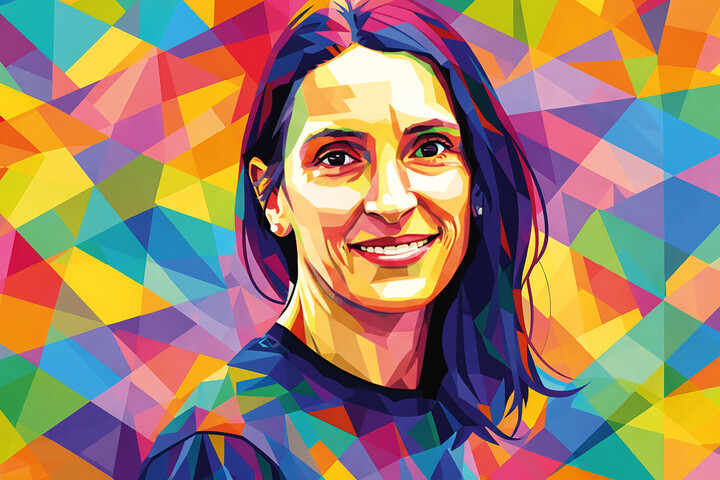

In Profile: Sabine Sonnentag
She is among the world’s most frequently cited scholars: Sabine Sonnentag. After starting out as the first and only female doctoral student in her department, the professor of work and organizational psychology at the University of Mannheim now looks back on a distinguished academic career.
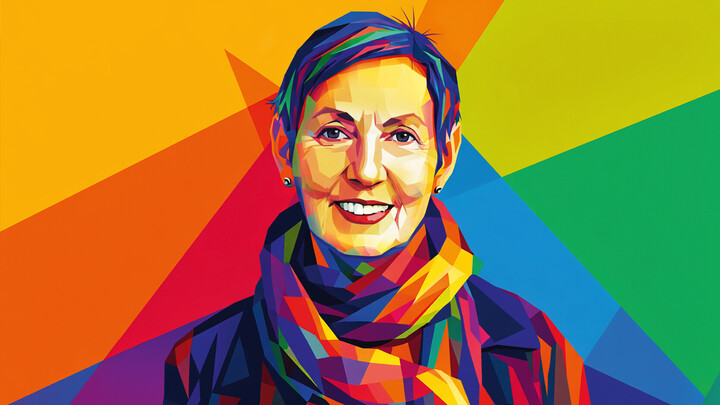
It doesn’t always take dense academic literature to shape a researcher’s path. Sometimes a simple autobiography, picked up by chance as a schoolgirl, is enough. Without Blackberry Winter by Margaret Mead, Sabine Sonnentag might not be where she is today. For the past 16 years she has held the Chair of Work and Organizational Psychology at the University of Mannheim, researching topics such as workplace stress and daily recovery from stress — yet she still thinks back to the book that set her on her course.
“For a long time, I had no idea what I wanted to study,” Sonnentag says in a measured voice. She vividly remembers the mix of curiosity and fascination that Mead’s writing sparked in her. “Mead is best known as an American anthropologist, but she also studied psychology and wrote about it in her autobiography. That immediately caught my interest.” Sonnentag began reading more about the field and, in 1980, enrolled at Freie Universität Berlin to study psychology.
Another turning point came in her very first week at university. An introductory lecture on workplace stress introduced her to work and organizational psychology — the field that would shape her research ever since. “The forms and causes of stress have changed over time, but fundamentally the topic is just as relevant today as it was then,” she says.
Like many students, she admits, she experienced phases when motivation waned. “There were times when I wondered what it was all for,” she recalls with a laugh. Once again, the answer sat on her bookshelf. “When I picked up Mead’s book again, I felt reassured that psychology was the right choice. What fascinated me most was the way she described the psychological experiments.”
The department’s first female doctoral student
After completing her degree, Sonnentag pursued a doctorate at TU Braunschweig — as the first and only woman in the Department of Applied Psychology. “At first that felt a bit weird,” she says. “I don’t think it made things harder for me, but there were comments like, ‘Oh, you’re pursuing a doctorate — that’s quite something for a woman.’ You don’t really hear that anymore.” At the same time, she adds, she knew female scholars at other universities. “So I knew I wasn’t alone.”
Even during her doctoral years, Sonnentag was unsure which direction her career might take. “It wasn’t until late in my doctorate that I realized what I wanted most was to do research and teach at a university,” she says. After finishing her doctorate, she moved to the University of Giessen in 1991, completing her habilitation there six years later.
In the years that followed, she held positions in Giessen and Amsterdam, returned to Braunschweig, and later accepted a professorship at the University of Konstanz. In 2010 she was appointed to Mannheim. “The university’s strong focus on business, economics, and social sciences fits perfectly with my research interests,” she explains. “And the Rhine–Neckar metropolitan region offers an ideal environment for someone working in organizational psychology, given the concentration of major companies here.”
Exploring stress and recovery
“My team and I focus primarily on how people can remain healthy and motivated over the long term,” Sonnentag says, summarizing her research. This means looking both at workplace conditions and at employees’ well-being: how people cope with stress and what best supports recovery. “Our main finding is that mental detachment from work is essential for effective recovery,” she explains. Whether that happens during breaks or only after the workday ends is one of the questions her research explores, along with which activities most effectively help people switch off mentally. “Physical exercise, for example, is beneficial for many.”
After nearly four decades in the field, Sonnentag’s sustained contributions have earned global recognition. In both 2024 and 2025 she was listed among the world’s “highly cited researchers,” a distinction awarded annually by analytics firm Clarivate. Her work has been cited more than 21,000 times.
To unwind after long days of lectures, research projects, and administrative demands, Sonnentag spends as much time as possible outdoors. “A good hike is one of my favorite ways to relax,” she says. “I also enjoy traveling and discovering new places.” And Margaret Mead’s autobiography? “I no longer have it, unfortunately,” she says, a little wistfully. “But I would be very curious to read it again now, with everything I’ve learned since.”
Text: Jessica Scholich / April 2026