
Study Economics
Bachelor's Program in Economics

Additional program facts and information
Language proficiency
You need to be proficient in German (see “Application and selection”). In addition, a good level of English proficiency is recommended.Program start
Fall semester (September)
Academic calendarSemester fee
EUR 194 (more information)
Tuition fees for international students from non-EU countries: EUR 1,500
Tuition fees for a second degree: EUR 650Possible master’s programs
- Master’s program in Economics (M.Sc.)
- Mannheim Master in Management (MMM) (M.Sc.) (at least 36 ECTS credits in Business Administration are required)
- Mannheim Master in Finance, Accounting and Taxation (M.Sc.) (at least 36 ECTS credits in Business Administration are required)
- Mannheim Master in Operations and Supply Chain Management (M.Sc.) (at least 36 ECTS credits in Business Administration are required)
- Mannheim Master in Data Science (M.Sc.) (at least 70 ECTS credits in Computer Science, Mathematics, or Statistics are required)
- Mannheim Master in Social Data Science (M.Sc.) (at least 48 ECTS credits in Computer Science, Mathematics, Statistics or empirical research methods are required)
- Master’s program in Mathematics in Business and Economics (M.Sc.) (at least 80 ECTS credits in Mathematics are required)
- M.A. Master’s program in Sociology (M.A.) (at least 24 ECTS credits in Mathematics, Statistics, quantitative methods or Methods of Empirical Social Research are required)
- M.A. Master’s program in Political Science (M.A.)
- Master’s program in Culture and Economy (M.A.) (fast-track master's program and proof of language proficiency, if applicable)
Program overview
Economics examines, at the micro level, how people make decisions about scarce resources of all kinds. At the macro level, it looks at entire economies and analyzes how they function and develop. Typical questions include, for example:
- How can economic policy help address the climate crisis?
- How does artificial intelligence influence the economy and our jobs?
- What impact does immigration have on the economy?
- Why is the independence of the European Central Bank important?
During the bachelor’s program, you will attend classes on, for example: basic economic principles, microeconomics, macroeconomics, economic policy, public finance, mathematics, econometrics and academic writing and research.
You can also combine your degree program in Economics with a minor, or in some cases even with multiple minors. You can combine Economics with Mathematics, Law, Business Administration, Business Informatics, Philosophy, Political Science, Sociology, and Psychology.
You can also attend seminars to develop key competences such as intercultural competencies, conflict management, presentation techniques, and time management.
Distribution of ECTS credits You will complete 103 ECTS credits in the introductory area and 77 to 85 ECTS credits in your elective modules.
Why study the bachelor’s program in Economics at the University of Mannheim?
Outstanding quality in research and teaching
Studying in Mannheim means studying at one of the most renowned institutions for Economics and Business Administration in Europe. Independent national and international rankings, including the CHE university ranking, the Times Higher Education ranking by subject and the QS University ranking, have confirmed the outstanding quality of the research and teaching at our university on a number of occasions. The program in Economics at the University of Mannheim was again number one in the 2023 CHE university ranking. Take a look at the rankings here.Broad opportunities for specialization
The bachelor's program in Economics at the University of Mannheim is characterized by thorough instruction in economic theories, early inclusion of empirical methods, and the combination of teaching and experience. The exceptionally broad range of modules on offer within the specialization area enables you to tailor your studies to your interests.Excellent research-orientation
Thanks to the large number of chairs and professorships, as well as the close cooperation with non-university research institutes (such as the ZEW – Leibniz Centre for European Economic Research) students have exceptionally diverse opportunities to contribute to research as student assistants.By the way: According to StudyCheck.de (2023), 96 percent of students would recommend their degree program at the University of Mannheim to others.
What is special about the bachelor’s program in Economics at the University of Mannheim?
Career opportunities
As an economist, you will understand how people make decisions, develop an understanding of macroeconomic relationships and learn how to work with data.
This opens up a wide range of career opportunities for you—for example in ministries, international organizations, think tanks, the European Commission, and companies. Administrative departments at federal, state and community institutions, the European Central Bank, the Bundesbank, the Federal Statistical Office, as well as treasuries and associations are some of the most important employers for economists. In addition, it is possible to work in business consulting or business journalism.
Economists can also pursue a career in academia at higher education and research institutions in Germany or abroad.
Studying abroad and internships
Studying abroad
The University of Mannheim is well-connected internationally, and has around 450 partner universities around the world. In the bachelor’s program in Economics, spending a semester abroad is optional. However, the exchange coordinators at the Department of Economics are happy to support you as you prepare to study abroad. The ideal time to study abroad is during the fifth or sixth semester of the program.Internships
We recommend that you complete one or two internship(s) in a relevant sector before you graduate. The university’s Career Network can help you find a suitable internship. An internship can be recognized as part of your degree program.Interests and skills
If you wish to study Economics, you should
- be interested in economic concepts and relationships,
- be comfortable with mathematics*,
- be able to think abstractly, and have
- strong verbal and written communication skills as well as the
- ability to develop logical and coherent arguments, and
- strong text comprehension skills (including complex and English-language texts).
*The Department of Economics bases its mathematical requirements for first-year students on the catalog of minimum requirements for mathematics (Mindestanforderungskatalog Mathematik v3.0), for students of Economics, Business Administration and STEM subjects at higher education institutions in Baden-Württemberg. The refresher course in mathematics enables students to brush up on their math. You should be particularly interested in analyzing mathematical notation as this is required in many courses.
Financing and funding
Scholarships
The University of Mannheim offers various scholarships. This funding enables you to focus on your academic achievements and continue your voluntary work alongside your studies.
Scholarship overview
Funding opportunities for international degree-seeking studentsFinancial aid for students
The Studierendenwerk is the first place to contact if you have any questions on how to finance your studies. They will give you advice on BAföG and tell you about other funding options.
Go to the StudierendenwerkApplication and selection
Important information on the awarding of study places
- For your application to be successful, you must apply in due time and form and fulfill the admission requirements for your chosen program of study.
- If a program of study is selective, the selection criteria set out in the relevant selection statutes apply in addition to the admission requirements. The University of Mannheim does not apply a numerus clausus system (grade-point average for admission to certain programs of study).
- All of our bachelor's programs require German language skills. If you do not have a German university entrance qualification (Abitur or equivalent qualification), you must submit proof of proficiency in German at C1 level.
The bachelor’s program in Economics is currently selective. The following selection criteria are taken into account:
- grade average achieved in your university entrance qualification as well as
- work experience, internships, and voluntary positions that are relevant to the degree program in Economics.
Application period
- Selective programs: from 1 June until 15 July
- Non-selective programs: from 1 June until 31 August
Program structure
Semester 1
- Fundamentals
- Grundlagen der VWL
- Analysis und lineare Algebra A
- Finanzmathematik
- Wirtschaftsgeschichte
- Recht
Semester 2
- Fundamentals
- Statistik I
- Makroökonomik A
- Mikroökonomik A
- Elective modules
- 1 module
Semester 3
- Fundamentals
- Makroökonomik B
- Mikroökonomik B
- Statistik II
- Elective modules
- 1 module
Semester 4
- Fundamentals
- Finanzwissenschaft
- Grundlagen der Ökonometrie
- Wirtschaftspolitik
- Elective modules
- 1 module
Semester 5
- Elective modules
- about 5 modules
Semester 6
- Elective modules
- about 4 modules
- Bachelor’s thesis
- You choose from modules in Economics (including Wirtschaftsgeschichte, Statistik and Ökonometrie) or from the following minors: Mathematics, Law, Business Administration, Business Informatics, Philosophy, Sociology, Political Science, and Psychology.
You also complete an online course on academic research and writing.
The structure of the degree program may vary depending on the minors selected.
Course names are listed in the original language.

I decided to study Economics in Mannheim because the university did really well in the latest rankings.
I came to Mannheim for a day and looked around the city and the university, and I knew that I wanted to study here.
I think it’s great that students work on major economic topics, like unemployment and economic growth, from their first semester onwards.

The good support network, the large number of elective modules available, and the direct communication between teachers and students are all factors that make you want to study Economics in Mannheim. Discussing topics related to economic policy really makes the subject come alive. That’s what I love about it. Be active, get involved, and have fun discussing economic problems. The university gives students lots of great opportunities to get involved with student organizations and clubs.

Mannheim is a great place to study. The university is renowned, the city is diverse, and although I’ve already been here for a year, the palace still impresses me! I really like how I can tailor a large part of my program to my interests. What I particularly appreciate is the department’s willingness to offer courses that students are interested in and that explore new approaches. Another big plus is the variety of student organizations and clubs at the university. I’ve made many friends here, and am having a lot of fun.
In the VWL Lounge, Mannheim students of the program in Economics and their professors come together to talk about studying and student life in Mannheim, as well as current research topics.
In this episode, Elisabeth Jeßberger talks to Professor Antonio Ciccone. Elisabeth is the sixth semester of the bachelor’s program in Economics and Antonio Ciccone holds the Chair of Economics, Macroeconomics, and Financial Markets.
Their conversation covers migration, the requirements for studying Economics, the role of mathematics, and possible career paths.


Other degree programs you may be interested in ...











Contact
Dr. Thorsten Lindenbauer (he/him)
Department of Economics
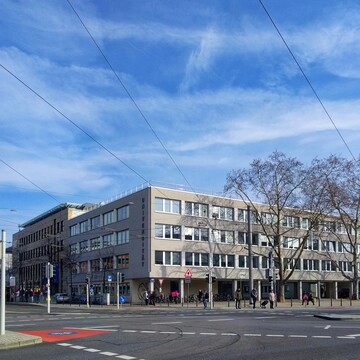
L 7, 3–5 – Room 409
68161 Mannheim
Sprechstunde nach Vereinbarung. Bitte kontaktieren Sie mich bevorzugt per E–Mail.

Dipl. Vw. Linda Köhler (she/her)
Department of Economics
L 7, 3–5 – Room 420
68161 Mannheim
Open consultation: Tuesday, 9:00 – 12:00 a.m. or by prior arrangement by e–mail. Please contact me by e–mail outside of the consultation hours.
Office hours will not be held on 6 and 13 October.
Admissions Office
L 1, 1 – Room 157, 158
68161 Mannheim
Our students have voted:
The University of Mannheim ranks first on the Studycheck.de portal
and is the "Most Popular University with 5,000 – 15,000 students” in Germany!