

MaDaLi² Project
In a digitalized world, the handling of data plays a central role.

Data literacy can be understood as "key competence of the 21th century“ that enables people not only to collect and analyze data, but also to critically evaluate and interpret it in a meaningful way. This competence is essential for making well-founded decisions, whether in academia, business or everyday life. Against this background, the University of Mannheim is expanding its extracurricular curriculum with the eLearning course MaDaLi2, with which we want to give our students the opportunity to acquire basic, practice-oriented data skills.
Data literacy for students of all disciplines
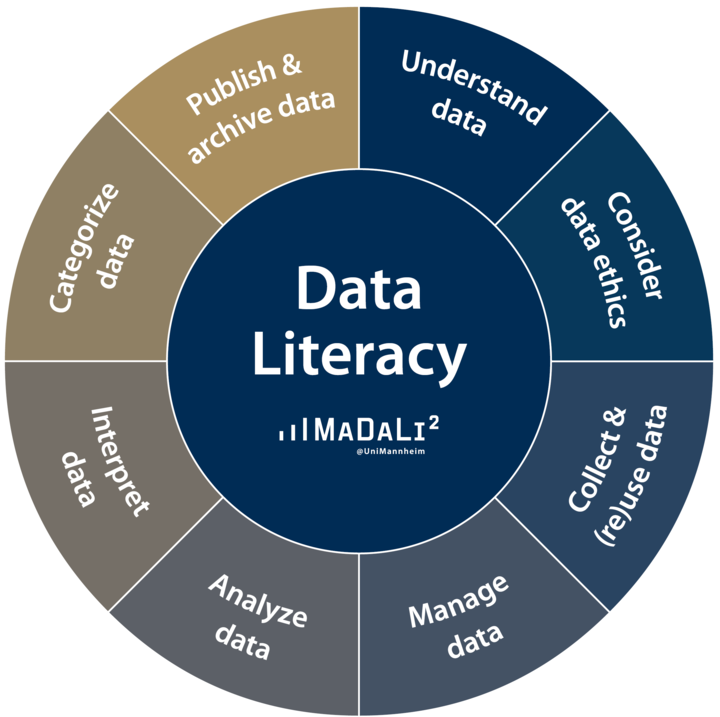
The course was developed by the Teaching and Learning Center (ZLL), the University Library (UB) and representatives of the Business School (chair held by Stahl) and the School of Humanities (chair held by Altvater-Mackensen and chair held by Naab) . It offers students at the University of Mannheim interdisciplinary knowledge of theoretical principles and practical skills for dealing with data.
The course consists of eight modules, which are also based on the data literacy framework of Schüller et al. The learning modules can be completed flexibly in self-study phases. Students can also take selected individual modules. No previous knowledge is required to take part in the course.
Module overview
Module 1: Understand data
- Basic knowledge of the concept of data literacy
- Data in everyday life and research
- Teaching methodological skills (qualitative and quantitative research)
- Teaching methodological skills (qualitative and quantitative research)
- Ethical problems in dealing with data
Module 2: Consider data ethics
- Data protection
- Copyright law and license law
- Introducing the concept of personal data
Module 3: Collecting and (re)using data
- Explaining qualitative and quantitative data collection using various data collection methods
- Empirical studies
- Open Data
- Dealing with protected data
Module 4: Managing data
- Metadata and documentation
- Importance of key figures
- Data conversion
Module 5: Analyzing data
- Qualitative and quantitative methods
- (Explorative) data analysis and cleansing
- Introduction to statistical key figures
- Basics of inferential statistics and evaluation of sample data
- Recognizing patterns and trends in data
- Data visualization
Module 6: Interpreting data
- Types of bias
- Pitfalls in the interpretation of results
- Biases in data visualizations
Module 7: Classifying data
- Critically classifying and evaluating data
- Interpreting data analyses
Module 8: Publishing and archiving data
- Publishing data sustainably in repositories
- Subsequent use and long-term preservation
- Introducing the FAIR principles
- Open Science and Open Access
- Excursus on the National Research Data Infrastructure (NFDI)

NEW: The MaDaLi² e-learning course as an Open Educational Resource (OER)
Bilingual e-learning program MaDaLi² available for download and integration into your courses
Our newly published e-learning offering is now available online at the Zentrale Repositorium für Open Educational Resources (ZOERR). The materials are bilingual (German/English) and can be downloaded in their entirety, enabling flexible learning and easy integration into your teaching.
Use the materials anytime, anywhere for preparation, in-depth study, or as a compact reference work.
You can find the link to ZOERR here.
Contact