
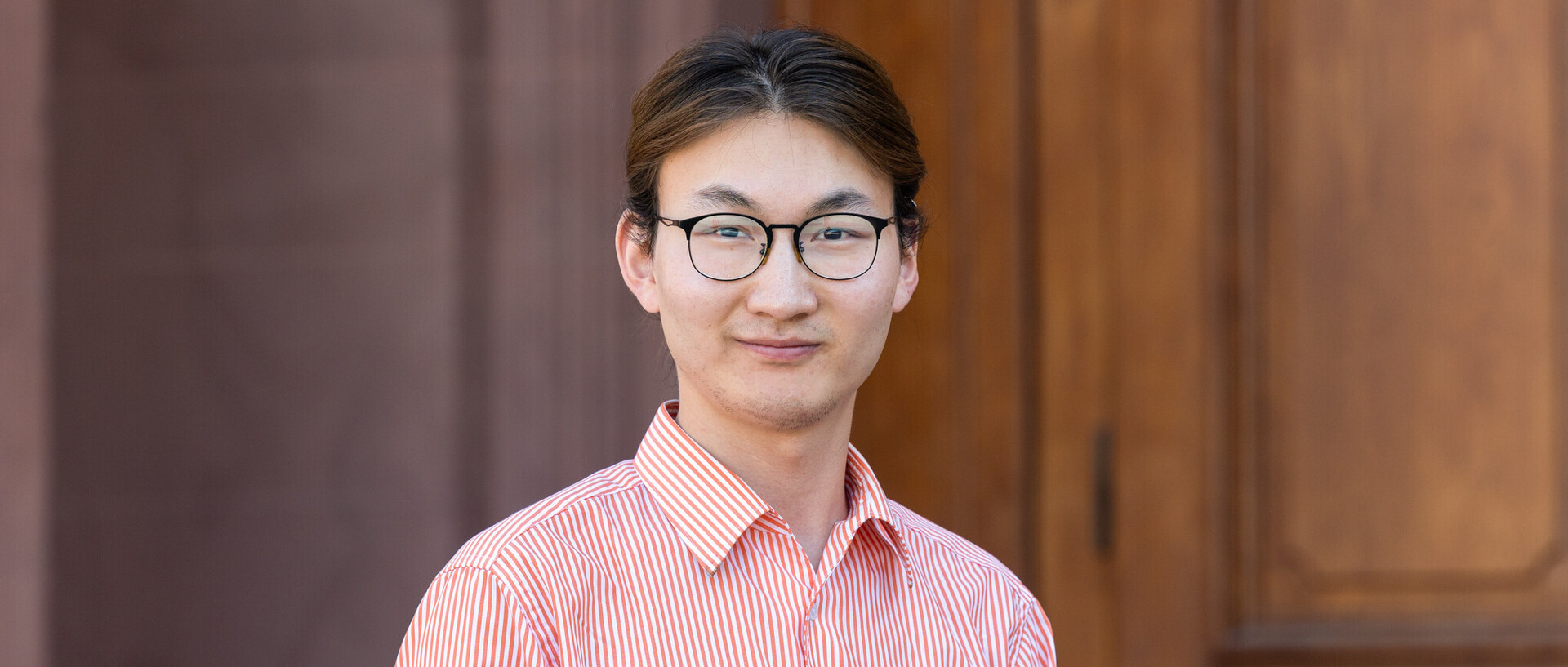
“The University of Mannheim Doesn't Just Give You Fish, It Teaches You How to Fish”
Even as a teenager, Khishigtugs Amarbayasgalan dreamed of studying in Germany one day. After completing a bachelor's degree in Sociology in the Mongolian capital Ulaanbaatar, he has realized this dream: Today, the 26-year-old is in the third semester of the master's program in Sociology in Mannheim. In his myUniMA story, he talks about what excites him about his field of study, where he likes to spend his free time, and what aspirations he has for his professional future.
Tell us a little bit about yourself: Where did you grow up and where did you study before coming to Mannheim?
I grew up with my grandfather on the outskirts of Ulaanbaatar, the capital of Mongolia. From an early age, I witnessed a lot of poverty and violence, which led me to ponder the meaning of life. When we discussed philosophy at school, I found my answer: it lies in loving my fellow human beings. This inspired me to study Sociology in order to understand society more deeply and thereby bring about positive change. Since Sociology originated as a discipline in Germany, France, and England, I was determined to study in Germany. In preparation for this, I first completed a bachelor's degree in Sociology at the National University of Mongolia.
Did you proceed directly from your bachelor’s degree to your master’s program?
No, after completing my bachelor's degree, I first gained practical experience in a think tank organization. In addition to working on academic papers, I conducted training courses on human rights, gender, and political ideology for approximately 15,000 participants. To be better prepared for the English-language master's program, I then spent two years in Ireland. In parallel to attending English-language courses, I worked at a factory and later as a social care worker. This enabled me to apply to German universities afterwards.
What made you decide to pursue your master's degree in Mannheim?
I chose the master's program in Sociology at the University of Mannheim for two reasons. First, the program is taught entirely in English, which allows me to study here even without sufficient German language skills. And secondly, the University of Mannheim’s School of Social Sciences enjoys an excellent reputation.
What excites you about your field of study, Sociology? And what do you particularly like about the master's program at the University of Mannheim?
I like to think of Sociology as an empowerment to “sociologize,” by which I mean looking at people's lives in connection with the social structures that surround them. It is fascinating to see how our consumer behavior or dating apps, for example, influence our view of constructs such as love. I am particularly interested in analyzing inequality. The master's program here allows me to deepen my knowledge of the various dimensions of inequality in areas such as education, wealth, and health, and to look at them from different perspectives. I also think the many additional academic opportunities here are great. Last year, I was able to participate in a winter school in Tilburg, Netherlands through ENGAGE.EU and gain knowledge about the legal and political frameworks for addressing socio-ecological challenges.
How do you spend your free time during the semester and/
I like to spend the semester break discovering other European countries. From Mannheim, it's only a few hours to Zurich, Paris, Vienna, or Prague – which is great! During the semester, I regularly take part in the free sports courses at the Institute of Sports and work out boxing and playing basketball, volleyball, and table tennis. I also work at the institute as a student assistant and coordinate the course program for two of the sports halls.
What was your start in Mannheim like? What challenges did you encounter? And what helped you settle in?
I still clearly remember arriving in Mannheim on a Sunday. I was very surprised that almost all shops and many restaurants were closed on Sundays in Germany, making the streets very quiet. Unfortunately, I accidentally locked myself out on my first day and learned that in Germany, closed doors are automatically locked. Now I always make sure I have my key with me before leaving the house! The support I received from the International Office after my arrival was particularly helpful. Among other things, I took part in excursions to nearby cities such as Stuttgart, Frankfurt, and Heilbronn, which helped me to make contacts with other international students from all over the world.
Is there anything you miss from your home country?
In Mongolia, we have significantly more karaoke bars where you can reserve private areas just for your friends, which I miss a little here. And I wish I had brought my traditional Mongolian clothes with me to wear on special occasions.
What would you like to do after completing your master's degree? Do you already have an idea of where you would like to live?
After completing my master's degree, I would like to gain a few years of work experience in Europe in the field of social sciences and humanities, perhaps in Ireland again. After that, I would like to return to Mongolia and contribute to the country’s economic and social development. One of my passions is writing research articles. During my bachelor's degree, I participated in two conferences and was awarded the first prize on both occasions. And one of my papers on the 4-day week initiative was even selected for a specialist conference of the British Sociological Association last fall, which I consider a great honor. In addition, I like to take up sociological key concepts in my own books in order to introduce them into the social discourse in Mongolia. I published two books during my bachelor's degree and am currently working on another. What I am learning here at the University of Mannheim is helping me a lot to develop my own thoughts. And I think that's really great: The University of Mannheim doesn't just give us fish, it teaches us how to fish!
Interview: Julia Schöfthaler / January 2026