Recap of the Diversity Week 2025: In the Same Schloss Together: Between Walls and Ways Forward
Making diversity visible—through science, culture, and networking
The contribution by “Hurdle the World,” best friends Alexander Källner and Lovis Wiefelspütz, about their trip around the world to over 45 countries was particularly moving. Alexander has a physical disability, and Lovis is currently undergoing tests for an ADHD diagnosis. On their travels, they documented what mutual trust and support can mean for inclusion and what it means to go from being best friends to being caregiver and care recipient: An example of this was their ascent of Cotopaxi in Ecuador, which Lovis managed with Alexander on his back.
Equally moving was a presentation by Viktor Boecking from the University Library on “Jewish Women under National Socialism.” He presented five yellowed books—novels but also medical reference works—bearing the initials of three Jewish women from Mannheim. Boecking impressively described the fate of a nurse who had escaped the Great Deportation in Baden in 1940 but was nevertheless murdered two years later in the Auschwitz concentration camp. The Mannheim provenance research on Nazi-looted property in the Mannheim Library is investigating the fates of these women and their relatives with the aim of returning the books to their relatives.
The Department of Equal Opportunity and Diversity hosted an Academic Lunch. The active participation of various departments—including the Psychology department, the Business School, and the School of Humanities—was proof of the great interest in diversity topics. The Academic Lunch was an indicator of the great interest in the diversity topics researched at the University of Mannheim. The event was opened with three short presentations by researchers regarding the topics of stigmatization, gender bias, and political representation of queer people. Dr. Leo Schmallenbach explained in his presentation how prejudices against women lead to scientists being cited less frequently if they are supervised by a woman instead of a man as part of a mentoring program. Dr. Constantin Wurthmann presented his current work regarding the political representation of queer people and was able to show that lesbian, gay, bisexual, and trans* people attach great importance to being represented by queer politicians. Dr. Rainer Freudenthaler highlighted in his presentation the conditions under which newspapers tend to portray certain ethnic and religious groups rather negatively or rather positively. Afterward, there was room for the discussion of other works in a poster session, which resulted in a lively exchange between the around 20 participants.
The Network Event for Female PhD Students & Postdocs offered the participants an opportunity to discuss the topic of networking as women in science after an input presentation by Professor Zeynep Tuncer (DHBW). Together with Professor Zeynep Tuncer, the participants engaged in a lively discussion about whether women should adopt rather male-connoted behaviors in order to network more successfully. After the presentation, the participants had the opportunity to exchange ideas and network. The participants enthusiastically seized this opportunity, which clearly showed that interdisciplinary network meetings at the University of Mannheim are of great interest.
Main event: Democracy, equality, and digital discourse
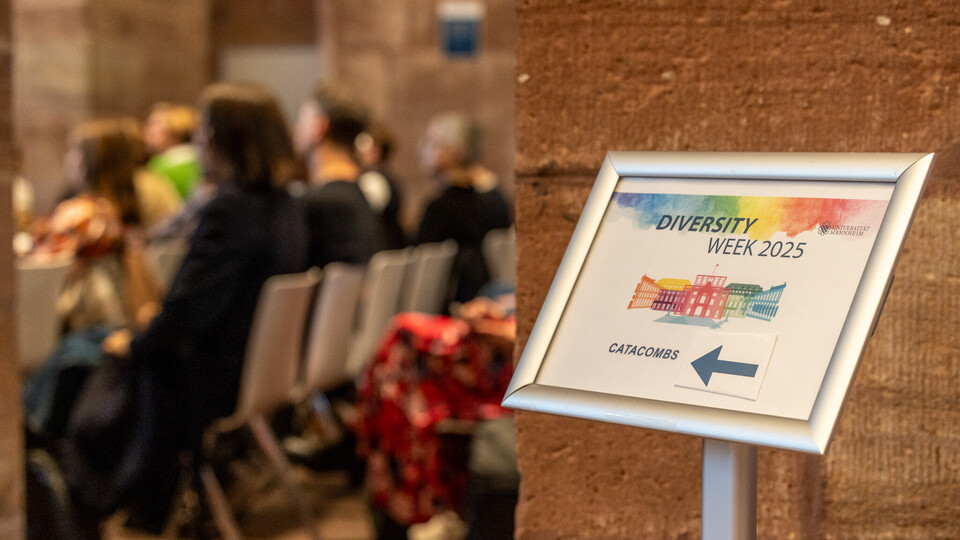
The highlight of the week was the central evening event on 15 October in the Katakomben, which was attended by around 70 people. Under the title “A Room for Change? Current Challenges for Democracies,”Vice President Professor Heiko Paulheim opened the evening, emphasizing the importance of inclusion and equal opportunities for a vibrant democracy. The evening was moderated by Sabine Kußmaul, Head of the Department of Equal Opportunity and Diversity.
This was followed by two exciting presentations—unfortunately, one presentation had to be canceled for health reasons:
- Professor Jessica Steinberger (HS Mannheim) spoke about the online phenomenon of tradwives and how traditional roles and toxic masculinity norms are gaining new visibility on social media.
- Dr. Oliver Rittmann (MZES) presented the results of his study on gender-specific attention in the Baden-Württemberg Landtag and showed that speeches by female politicians are often less well received there.
The latter presentation was followed by a lively Q&A session including discussions on how female politicians can get more attention from male colleagues for their speeches and which structural or unconscious prejudices could play a role in this. The presentation on the tradwife phenomenon was also discussed enthusiastically: Why are such roles currently gaining popularity on social media again? What social uncertainties do they reflect—and are we really discussing the same issues as 20 years ago? The discussions clearly showed that there is still a need for further research.
The evening was accompanied by a musical performance providing special moments by Laura di Natali (she/they) from the Popakademie Baden-Württemberg (Mannheim).
Exchange and getting involved on campus
On the occasion of the Diversity Week, the Department of Equal Opportunity and Diversity, the International Office, and the AStA provided information on their work at a joint information stand in the Schloss. The AStA took part with a campaign against sexism and racism, which was made visible with posters on campus. The numerous discussions with students, staff, and guests on topics such as participation and accessibility as well as the “Check your privileges” poster campaign showed how relevant diversity topics are at the University of Mannheim.
Diversity remains an important topic
With the Diversity Week 2025, the University of Mannheim has once again set an example of diversity and equality. The Department of Equal Opportunity and Diversity would like to thank all contributors and participants for their commitment and inspiring contributions.