
Master's Program in History
Program ambassador

Hi, I’m Simon and I started studying History at the University of Mannheim in 2019. I've finished my bachelor's degree and am now in the master's program. Feel free to contact me if you have any questions about the program, Mannheim, or student life in general. I’ve been here long enough, so I’m sure I can answer your questions.
Why I chose this program
Students of the master's program in History study cultural systems and historical developments in society. Here in Mannheim, the program focuses on cultures and societies in Europe and America but also on economic, legal, and social history. We examine and explore all epochs from antiquity to the present day.
I study History because I think it's important to learn about the roots of our world today. Exciting interdisciplinary fields of research arise in particular from the many areas where the subject overlaps with other disciplines.
Studying at the University of Mannheim
What's special about the program?
The master’s program in History is research-oriented but also focuses on public relations, which makes it stand out from similar programs at other universities. This means that you will have special courses to learn how history can be communicated and put your knowledge into practice in the project seminar. This seminar extends over two semesters and you can, for example, curate a small exhibition. Since the program is more hands-on, it will help you transition from university to career.
The classes of the master's program are rather small, so you can work closely with the other students and teachers and get to know each other better. In addition, the Department of History has close ties to non-university institutions such as the Technoseum, the city archive, and the Reiss-Engelhorn-Museen. You also have the opportunity to complete a placement semester or spend a semester abroad at one of the many partner universities. The staff members of the University of Mannheim will be happy to help you with that.
Extracurricular activities
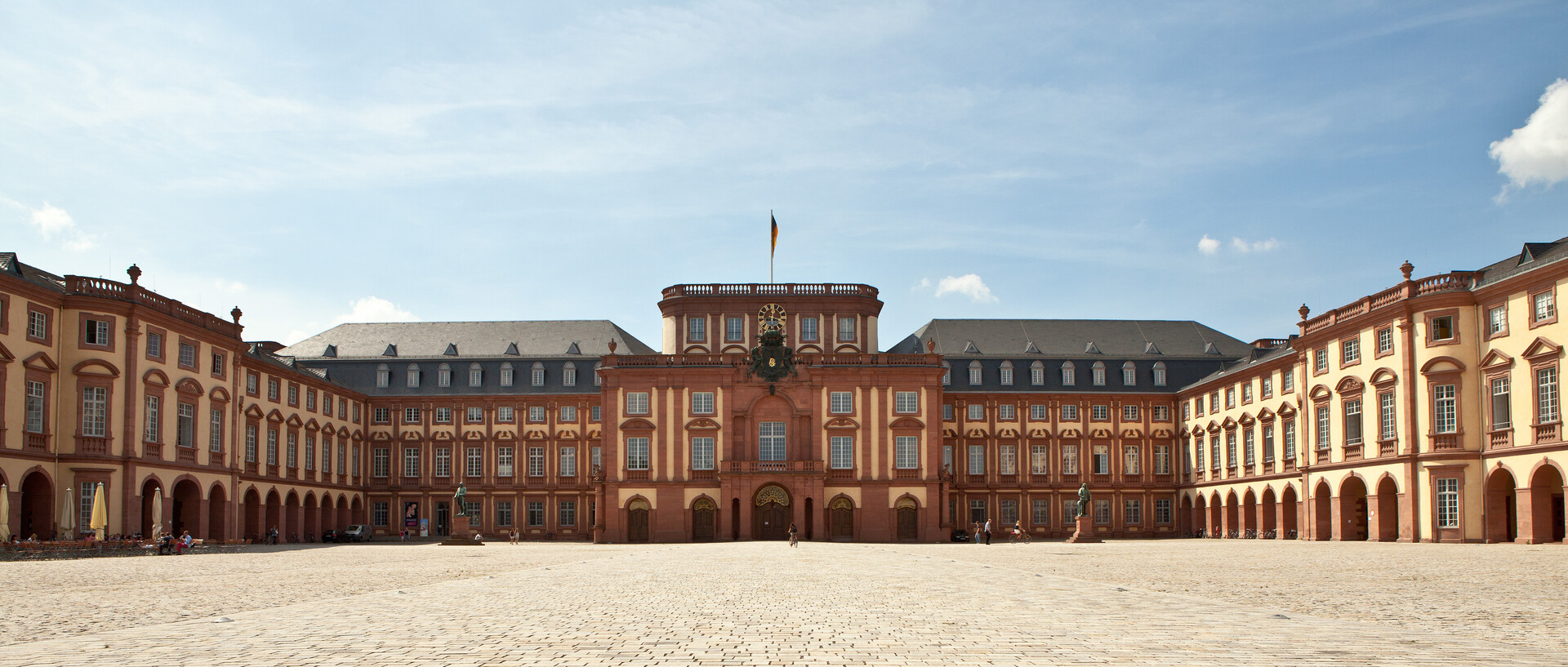
The rooms and libraries are very modern and well equipped. Outside the lecture halls and seminar rooms, the university impresses with its beautiful campus and the baroque palace, which is located in the city center.
In addition to the degree program, there are other reasons to study at the University of Mannheim: The members of the departmental student committee organize many interesting events such as the orientation week for first-year students, the film club, and a city trip. The departmental student committee also promotes the interests of all History students at the University of Mannheim. You can find useful information for first-year students in German on their website. In addition to the departmental student committee, you can volunteer in numerous other student organizations of all kinds that organize events and specialist lectures.
Sports enthusiasts are also in good hands at the University of Mannheim: The Institute of Sports offers an extensive sports program. The courses are usually free of charge and you can try out almost any sport imaginable. The activities range from Pilates and rowing on the Neckar to lacrosse. Everyone can find something they are interested in! Of course, we can't forget about the nightlife: In addition to the clubs, bars, and pubs in the city center and Jungbusch, the Schneckenhof parties, which take place every Thursday on campus and are organized by the individual departmental student committees, are particularly popular.
What you need to know
Clichés
Myth 1: History is just about chattering. That’s not true. However, you need to be aware that certain skills are required for this program: You should be interested in history and enjoy reading, writing, and engaging in discussions. Overall, one could say: You will grow with the challenge!
Myth 2: Historians only memorize dates. That is probably the biggest misconception. Compared to subjects like Business Administration, you have to memorize much less. Although dates and facts do play a role in studying history, they are not overly important. At the beginning of your studies, you will acquire cross-epochal knowledge. However, understanding and applying this information is way more important than memorizing it. For example, when reading a source, you should be aware of when it was written and what developments played a role at that time.
Language proficiency
It is definitely recommended to be proficient in English. During your studies, you will often come across literature and sources that have only been published in English.
Depending on the region and epoch, other languages may also be useful. For example, Latin for ancient and medieval history, French for modern history, or Spanish for the history of Spanish-speaking countries. However, these skills are not mandatory.
Further information
Would you like to learn more about the program in History at the University of Mannheim?
Have a look at the program descriptions:
Would you like to start your studies at the University of Mannheim?
Contact
