
Study Business, Economics, and History
Bachelor's Program in Culture and Economy: History

Additional program facts and information
Language proficiency
You need to be proficient in German (see “Application and selection”). In addition, a good level of English proficiency is recommended.Program start
Fall semester (September)
Academic calendarSemester fee
EUR 194 (more information)
Tuition fees for international students from non-EU countries: EUR 1,500
Tuition fees for a second degree: EUR 650Possible master’s programs
There are various master’s programs you can study after successfully completing a bachelor’s program in Culture and Economy. You can pursue a master’s degree in Culture and Economy: History or focus exclusively on either humanities or Business Administration/Economics. Master's program focusing on humanities
- Master’s program in History (M.A.)
Master’s programs focusing on business administration:
If you plan to continue your studies with one of the following master’s programs, you should take the corresponding optional specialization module in the bachelor’s program (see selection statutes).- Mannheim Master in Management (M.Sc.)
- Mannheim Master in Finance, Accounting and Taxation (M.Sc.)
- Mannheim Master in Operations and Supply Chain Management (M.Sc.)
Master’s program focusing on economics:
To qualify for this program, you have to take the “Vertiefung Volkswirtschaftslehre” module while studying the bachelor’s program (see selection statutes).- Master’s program in Economics (M.Sc.)
Program overview
The bachelor's program in Culture and Economy is a combined degree program that brings together different subjects and academic cultures: a core subject in cultural studies from the School of Humanities and a combination major in Economics or Business Administration. The two subjects are linked, inter alia, by language practice courses focusing on Business Administration and Economics.
During modules in your core subject History, you analyze cultural systems and historical developments in society. Here in Mannheim, the program focuses on cultures and societies in Europe and America but also on economic, legal, and social history. In addition, you will gain an overview of all historical periods from antiquity to the present day.
For your combination major, you can choose between Business Administration and Economics.
- If you choose Business Administration, you will attend introductory courses on finance, marketing, management, business informatics, accounting, and production. The University of Mannheim places a strong emphasis on business ethics by offering corresponding courses.
- If you choose Economics, you will not only learn the fundamentals of economics but also acquire knowledge in the fields of analysis, statistics, and micro- and macroeconomics. Another particularity of this combination major is that it also includes economic history.
Distribution of ECTS credits
You will complete at least 180 ECTS credits in History and at least 60 ECTS credits in your combination major.Why study the bachelor’s program in Culture and Economy: History at the University of Mannheim?
Unique combination
The combination of culture and economy in a single program is unique in Germany. Earning a double qualification in the humanities and Business Administration/Economics broadens students’ horizons. Therefore, our graduates are highly sought after on both national and international job markets. Interdisciplinary perspective
The Department of History offers courses focusing on economic history for all epochs. For these courses, it often collaborates with the Department of Economics to enable students to take an interdisciplinary perspective on the different scientific subject areas.Collaborations
The Department of History collaborates with international higher education institutions and cultural establishments such as the MARCHIVUM (the city archive) or the Reiss-Engelhorn-Museen, which students of the program can benefit from.International focus
With 450 partner universities and students from 100 countries, Mannheim is one of the most international universities in the country and provides students with an inspiring learning environment that facilitates excellent teaching and research.Working in small groups and good student-teacher ratio
Students at the School of Humanities value the ability to work interactively in small groups and the favorable student-teacher ratio. The program managers will be happy to answer any questions you may have about organizing your studies. Academic advisors and teachers at the relevant department will help you with any questions about the program.Career opportunities
The bachelor’s program in Culture and Economy trains you to become a sought-after all-rounder with broad cultural and economic expertise, problem-solving skills, and flexible thinking. You can analyze complex issues and develop value-based solutions. This opens up a wide range of career opportunities for you:
Fields of activity related to cultural studies and the humanities
- Marketing
- Communications, public relations
- Media, journalism
- Cultural management
Fields of activity related to economics and business administration
- Sales
- Procurement
- Customer service
- Human resources
In addition, the integrated career-oriented module Wirtschaftskommunikation equips you with high-level communication skills and builds a bridge between the two subjects. It spotlights possible career opportunities and promotes insights into interesting areas of work as well as an early practical orientation.
In addition, a degree in History qualifies you to work in cultural management, publishing, education, museums, or archives. After completing your master’s degree, you can also pursue an academic career as a historian.
Studying abroad and internships
Studying abroad
The School of Humanities maintains collaborations with more than 150 partner universities worldwide. Our team for international affairs will support you in planning a stay abroad. The perfect time for students to go abroad is the fourth or fifth subject-specific semester, but individual arrangements are possible. Studying abroad to enhance your intercultural competencies is recommended but not mandatory when studying this program. We also offer field trips and interdisciplinary seminars in cooperation with international universities.Internships
A six-week internship in Germany or abroad is an integral part of your studies. Further information and points of contact for all questions relating to internships and career entry can be found on the website of the School of Humanities.Interests and skills
If you wish to study Culture and Economy: History, you should
- be interested in history—from antiquity to the present day,
- have a very good level of German and a good level of English proficiency,
- have an academic interest in methods and theories,
- like to critically question and reflect on various topics,
- enjoy interpreting sources such as texts, artifacts, or visual sources,
- enjoy writing and reading academic texts,
- be interested in presenting theses and content.
For the combination major in Business Administration, you should be enthusiastic about marketing and management as well as business ethics and have good mathematical skills.
For the combination major in Economics, you should have very good mathematical skills and be interested in statistics and politics. You should be prepared to acquire and apply a lot of new knowledge within a short period of time.
Financing and funding
Scholarships
The University of Mannheim offers various scholarships. This funding enables you to focus on your academic achievements and continue your voluntary work alongside your studies.
Scholarship overview
Funding opportunities for international degree-seeking studentsFinancial aid for students
The Studierendenwerk is the first place to contact if you have any questions on how to finance your studies. They will give you advice on BAföG and tell you about other funding options.
Go to the StudierendenwerkApplication and selection
Important information on the awarding of study places
- For your application to be successful, you must apply in due time and form and fulfill the admission requirements for your chosen program of study.
- If a program of study is selective, the selection criteria set out in the relevant selection statutes apply in addition to the admission requirements. The University of Mannheim does not apply a numerus clausus system (grade-point average for admission to certain programs of study).
- All of our bachelor's programs require German language skills. If you do not have a German university entrance qualification (Abitur or equivalent qualification), you must submit proof of proficiency in German at C1 level.
This program of study is currently not selective.
Application period
- Selective programs: from 1 June until 15 July
- Non-selective programs: from 1 June until 31 August
The earlier you apply, the earlier you will hear back from us. This will make the start of your studies less stressful.
Program structure
For your combination major, you can choose between Business Administration (Option 1) and Economics (Option 2). You will study only one of these options.
Semester 1
- History
- Einführung in die Geschichtswissenschaft
- Exercise course: Historische Theorie or Archiv- und Quellenkunde
- Prep course: Altertum
- Introductory seminar and tutorial: Altertum or Neuzeit
- Prep course: Neuzeit
- Business Administration
- Lecture: Finanzmathematik
- Lecture: Quantitative Methoden
- Lecture: Marketing
Semester 2
- History
- Exercise course: Statistische Grundlagen
- Prep course: Mittelalter
- Introductory seminar and tutorial: Mittelalter
- Prep course: Neuzeit
- Business Administration
-
Exercise course: Current Topics UK/
US - Lecture: Grundlagen des externen Rechnungswesens
- Lecture: Management
Semester 3
- History
- Introductory seminar and tutorial: Wirtschafts- und Sozialgeschichte
- Introductory seminar and tutorial: Altertum or Neuzeit
- Business Administration
- Exercise course: Intercultural Business Communication
- Lecture: Finanzwirtschaft
- Lecture: Produktion
Semester 4
- History
- Lecture and exercise course: Altertum or Mittelalter or Neuzeit
- Exercise course: Wirtschaft und Geschichte
- Exercise course: Career Skills
- Internship
- Business Administration
- Lecture: Internes Rechnungswesen
- Lecture: Wirtschaftsinformatik
Semester 5
- History
- Lecture: Wirtschaft und Geschichte
- Lecture: International Cultural Studies
-
Seminar/
lecture: Interdisziplinäre Kulturwissenschaft
- Business Administration
- Lecture: Unternehmensethik
Semester 6
- History
- Advanced seminar: Wirtschaft und Geschichte
- Exercise course: Business Translation
- Bachelor's thesis
- Final oral examination
Course names are listed in the original language.

For me, the University of Mannheim stands out for its strong constituted student body and vibrant social life, fostered by the departmental student committees. The combination of History and Business Administration may seem unconventional. However, the subjects complement each other, as both historical background knowledge and the methodology of critically questioning the science of History with regard to the theories of Business Administration open up new perspectives.
Insights into studying Culture and Economy
Michelle is studying Culture and Economy at the University of Mannheim and shows her everyday life as a bachelor’s student at the School of Humanities.


Other degree programs you may be interested in ...







Contact

Caterina Katzer (she/her)
School of Humanities
Schloss – Room EO 282
68161 Mannheim
Tue 10–12 a.m.
Open consultation hours in room 282
Wed 10–12 a.m.
Online consultation hours – please make an appointment via https://www.phil.uni-mannheim.de/en/academics/virtual-office-hours/

Dr. Angelika Konrad-Schineller
School of Humanities
Schloss – Room EO 282
68161 Mannheim
Tue 10–12 a.m.
Open consultation hours in room 282
Wed 10–12 a.m.
Online consultation hours – please make an appointment via https://www.phil.uni-mannheim.de/en/academics/virtual-office-hours/

Admissions Office
L 1, 1 – Room 157, 158
68161 Mannheim
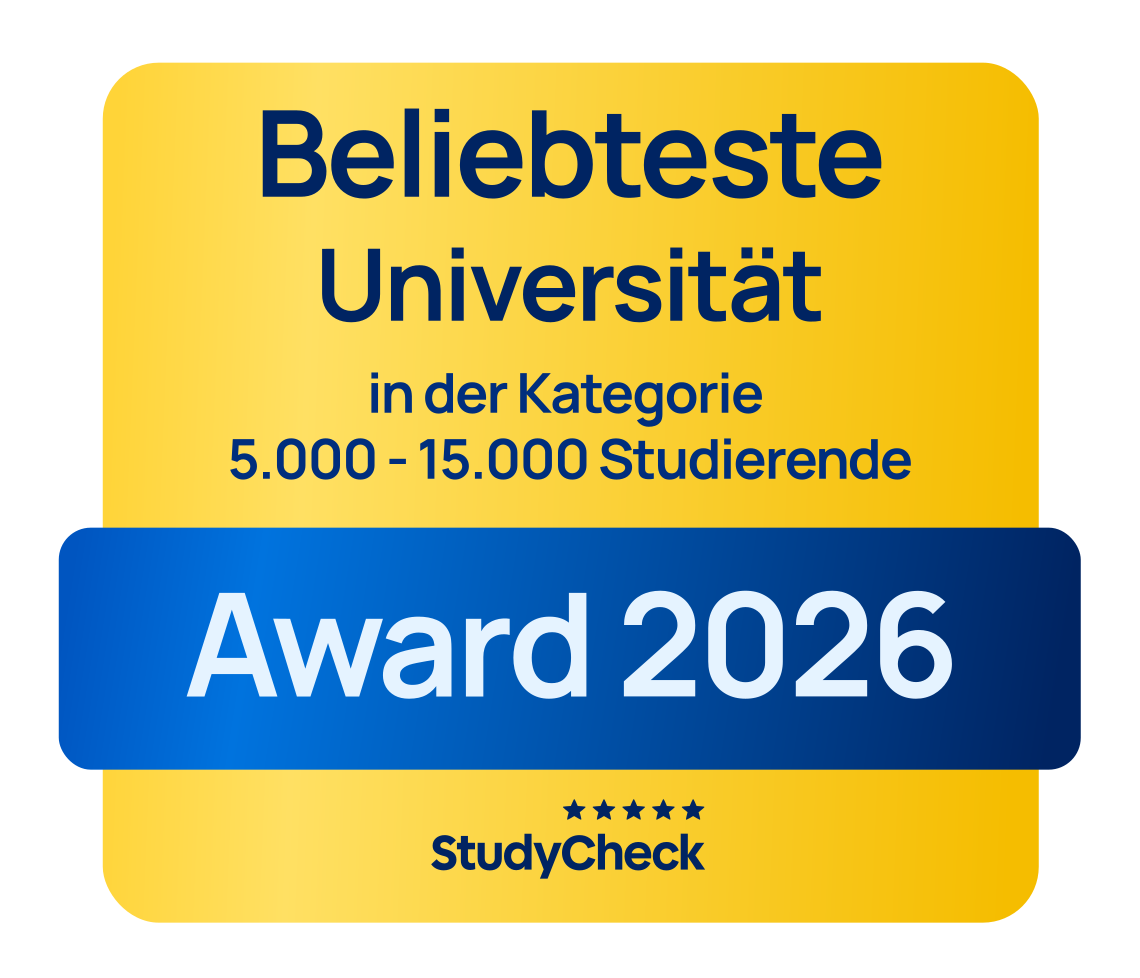
Our students have voted:
The University of Mannheim ranks first on the Studycheck.de portal
and is the "Most Popular University with 5,000 – 15,000 students” in Germany!